

























































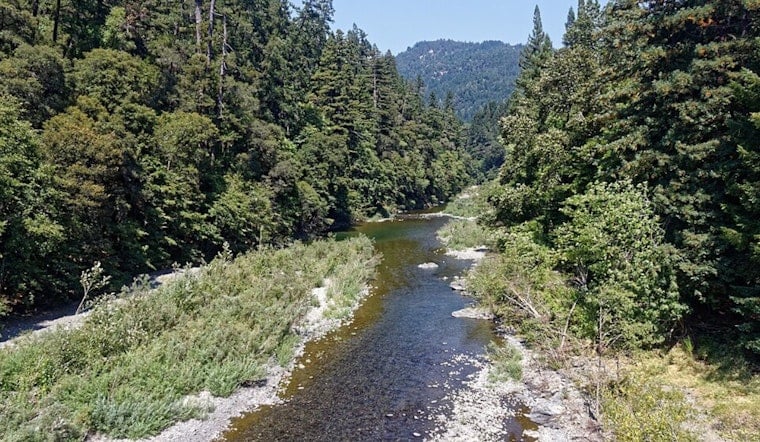
Last Tuesday, stretches of Redwood Creek in southern Humboldt suddenly turned milky white as a cloudy plume slid downstream toward the South Fork Eel River. State and county investigators say the opaque water came from drilling return fluid linked to crews boring beneath Highway 101 for the state’s middle-mile broadband build. Within days, cleanup crews were scooping settled sludge off stream margins while agencies scrambled to track where thousands of gallons of slurry had been placed on private land.
How drilling turns water into slurry, and why that is a problem
Horizontal directional drilling relies on a water-and-clay mixture, commonly bentonite, to lubricate the drill and haul cuttings back to the surface. That mix creates a watery return that has to be captured and managed. When fine clay hangs in the water column, it clouds the creek and cuts down fish feeding; when it settles, it can pack into the gravel spaces where salmon and steelhead spawn. Regulators say that a simple physical effect, not some hidden toxic chemical, is the reason for strict controls on drilling near salmon habitat.
A broadband megaproject in the background
The work in southern Humboldt is one piece of California’s Middle-Mile Broadband Initiative, the state Broadband for All program created by SB 156 that directed roughly $3.25 billion to build a statewide middle-mile network, according to the program overview. The state has teamed up with private developers for many route segments; Arcadian Infracom is the company building the Bay Area-to-Eureka “Redwood Route” that cuts through Southern Humboldt.
Paperwork says “exempt,” but with strings attached
Caltrans filed a CEQA Notice of Exemption for the Benbow-to-Redcrest segment on April 8, citing Public Resources Code section 21080.51, the statutory exemption created for SB 156 projects. That exemption comes with conditions such as construction monitors and biological protections, and Caltrans’ encroachment guidance notes that many middle-mile joint-builds still need coverage under the State Construction General Permit and a site-specific waste and stormwater management plan.
Where investigators say the slurry went
Engineers from the North Coast Regional Water Quality Control Board followed the milky plume upstream to a ditch draining from a private property on Briceland Road and photographed a second staging pit at the Meadows Business Park in Redway, where gray slurry had built up, according to local reporting and agency photos. The water board documented clay deposits in roadside ditches and instructed the property owner to hire a qualified professional to assess impacts and prepare a cleanup and mitigation plan. State fishery officers took samples and photographed the stored slurry while cleanup crews removed settled material from stream margins. As reported by Redheaded Blackbelt, investigators are still mapping where drilling waste was disposed.
Why salmon advocates were quick to speak up
Fisheries biologists note that June is prime rearing season for juvenile salmonids, and suspended clay can keep young fish from feeding while settled slurry smothers the insects and tiny gravel spaces those fish depend on. Consulting biologist Patrick Higgins described the cloudy water and its likely bentonite signature in an interview with KMUD News, emphasizing that the material can still injure aquatic life even if bentonite itself is considered inert. The South Fork Eel River has long been a focus for coho and steelhead recovery work, and state restoration plans and partnerships stress the need to lower chronic fine-sediment loads in the basin.
Investigations and what could come next
The North Coast Regional Water Board, California Department of Fish and Wildlife and Humboldt County all say they are investigating the disposal, sampling sites and chain of custody for the slurry. Discharging drilling slurry into waters without appropriate NPDES or Construction General Permit coverage or containment can trigger enforcement under federal and state water laws, and the statewide Construction General Permit spells out when stormwater plans and permitting are required. Humboldt County’s director of planning says the county is reviewing potential code violations as it consults with the contractor and property owners, and agencies say lab results and site assessments will determine whether cleanup orders or penalties follow. For documents on the CEQA exemption and what the state required on paper, see the Caltrans filing.
Arcadian’s public materials say the Redwood Route construction will continue through late 2026 as crews extend middle-mile fiber, but the Humboldt incident has left local advocates and regulators pushing for clearer, enforceable plans for how drilling waste is handled where salmon habitat is at risk. Agencies expect lab analyses and professional impact assessments to guide the next phase of cleanup and any corrective action.





