

























































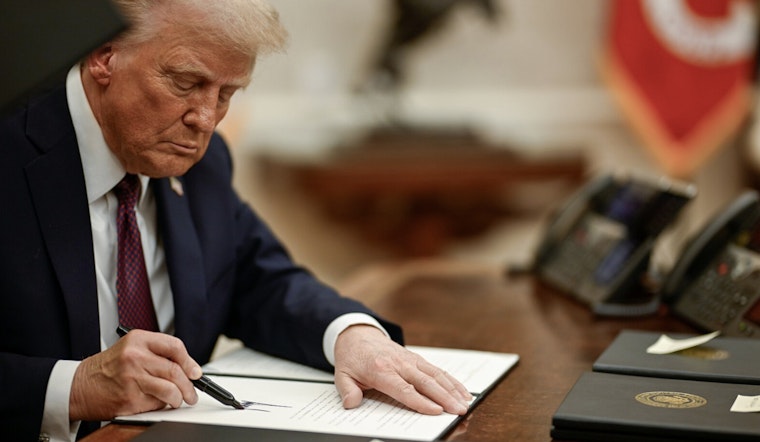
President Donald Trump's recent executive order threatening to cut federal funds from cities that maintain cashless bail practices has stirred significant debate. The White House has labeled these policies as a "government-backed crime spree," citing cases from New York, including the release without bail of individuals accused of smearing feces on a subway passenger and assaulting an NYPD officer, according to CBS News New York report.
Amid concerns raised by the president, the potential consequences for New York City could be considerable, with the NYPD at risk to lose up to $200 million, about 3% of its police budget. Despite these threats, Mayor Eric Adams has stood firm, stating, "We're going to always do our job. We're asking our other criminal justice partners to do theirs." This comment suggests a resolve to not buckle under federal pressure despite the possible financial blow, as reported by CBS News New York.
While Trump's administration squarely targets cashless bail as detrimental, Governor Kathy Hochul and other officials have defended it. According to a NBC New York article, Hochul criticized the executive order as "reckless." The governor underscored changes made to New York's bail laws over the last two years, reportedly resulting in a decrease in rearrests of people on pretrial release from 24% in 2020 to 17% in 2024.
The ongoing tussle extends to the mayoral race and beyond, with politicians such as upstate Congresswoman Elise Stefanik planning to write legislation to outlaw cashless bail, while City Councilwoman Tiffany Caban, a former public defender, argued, "We know that the research shows that instituting cashless bail in different jurisdictions does not increase crime." This divide reflects not just a local policy issue but a broader ideological clash over how to effectively balance criminal justice reform and public safety, as per CBS News New York.
Contentious as the debate may be, studies have been mixed regarding cashless bail's impact on crime. A 2024 Loyola University of Chicago report found no uptick in crime following Illinois’ cashless bail policy implementation, and a study by the Brennan Center for Justice noted "no statistically significant relationship" between bail reform and crime rates. In stark contrast, data from Yolo County, California, highlighted by the White House, showed a high recidivism rate for individuals released under a temporary cashless bail system, as reported by NBC New York.





.jpg)