

























































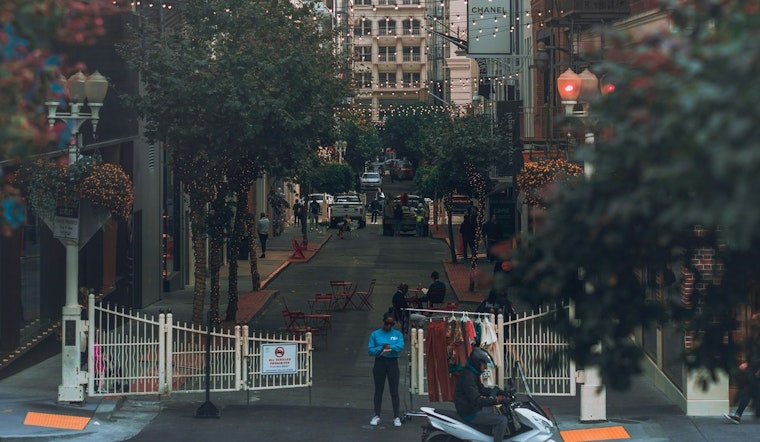
Brian Sheehy's concerns about Senate Bill 395 make sense on the surface—more restaurants competing for the same customers sounds threatening when you're barely surviving. But his "the pie is only so big" argument misses a crucial fact: Downtown's real problem isn't too much competition, but too few reasons to visit — too little foot traffic. As VCs love to argue, you can have 100% of something very small or 25% of something gigantic.
Sheehy, the Future Bars CEO, told SFGate that 20 new liquor licenses in Union Square and Yerba Buena would be "a dangerous approach" that could leave many businesses struggling. It's an understandable fear. But it assumes downtown's customer base is fixed—that there's a predetermined number of people willing to come downtown, and adding venues just divides them into smaller groups.
The data from San Francisco's own recent experiments suggests otherwise.
When Competition Actually Helps
Take the entertainment zones that Senator Wiener's earlier legislation made possible. According to the Mayor's Office, events at the Front Street entertainment zone have drawn over 21,000 attendees since launching. The businesses participating—Schroeder's, Harrington's Bar & Grill, and Royal Exchange—didn't cannibalize each other. They reported sales increases between 700% and 1,500% during events.
That's not splitting a fixed pie. That's baking a bigger one.
NBC Bay Area reports that entertainment zones are "reshaping our city into a dynamic destination where lively street events are becoming a cornerstone." The model demonstrates that when you give people more reasons to show up, they actually show up—and they spend money at multiple places, not just one.
The Real Barrier
Here's what makes the current system so problematic: according to Axios, new restaurant owners in San Francisco typically pay $200,000 or more for a liquor license on the secondary market. Recent sales have ranged around $190,000, according to License Locators.
That's not unique to San Francisco. WBUR reports Boston charges $400,000 to $600,000 on the secondary market. The Angel reports Los Angeles has climbed from $75,000 pre-pandemic to over $150,000, with brokers predicting $200,000 by summer. New York City licenses range from $10,000 to over $1 million depending on location, according to The Donut Whole.
The pattern is identical: state quota systems cap available licenses, forcing aspiring restaurateurs to buy from existing holders at whatever price the market will bear. It's a system that rewards whoever got in first and punishes everyone trying to enter now. SB 395's 20 new licenses at $20,000 each—restricted to downtown, non-transferable, and returned to the city if the business closes—sidestep this entire secondary market.
Downtown Is Already Betting on Itself
Despite the doom narrative, downtown San Francisco is seeing real investment. KTVU reports about two dozen new eateries and shops opened in Union Square during 2024 alone. Bombay Brasserie brought its global brand to the Taj Campton Place. Michelin-starred chef Akira Back opened ABSteak on Ellis Street. Rolex moved to Post Street. Nintendo is planning a major store for next year.
The Ferry Building tells an even stronger story. The Chronicle reports the landmark saw record foot traffic in the first quarter of 2025—2.5 million visitors—and expects to exceed 2019 levels this year. At least eight new food businesses have opened there in 18 months, including Nopa Fish, Parachute Bakery, and Arquet from the Michelin-starred Sorrel team.
More are coming. Restaurateur Kaïs Bouzidi is opening Hayati in the former Boulettes Larder space, according to the Chronicle. A16 is bringing southern Italian restaurant Lucania to the former MarketBar space, the Chronicle reports. Both target 2026 openings. These aren't Hail Mary passes—they're calculated bets on San Francisco's trajectory.
Protecting Existing Operators
The legislation includes specific safeguards that address concerns about devaluing existing licenses. SFGate reports the new licenses can only be issued through annual Alcoholic Beverage Control drawings, cannot be sold or transferred outside the designated hospitality zone, and are canceled—not resold—if an operator closes.
This means the 20 new licenses won't compete with the secondary market where existing operators might eventually sell their licenses. They exist in a separate system entirely, designed to lower entry barriers without affecting the substantial investments current license holders have made.
Ben Bleiman, founder of the SF Bar Owner Alliance and co-owner of Harrington's Bar & Grill, captured the tension perfectly when he told SFGate: "You have existing operators who have gotten through COVID and blood, sweat and tears to survive in that area, and the idea that there'd be a lot of new competition around them is both scary and potentially could be detrimental to them. But on the other side, we have this designated hospitality zone, and it is nowhere near living up to its potential. If we really want that area to go off and become something big, we have to do big things."
The Precedent Works
San Francisco has done this before. When the city created Type 87 licenses for underserved neighborhoods like Bayview, Portola, and the Outer Sunset starting in 2017, restaurants that received them reported meaningful impacts, according to Hoodline. The Dark Horse Inn in the Excelsior saw customers ordering cocktails instead of just beer, "which increases our check average significantly," co-owner Sean Ingram said.
These weren't businesses destroyed by new competition—they were businesses enabled by removing artificial barriers. The Type 87 program cost $13,800 instead of $300,000, making it possible for neighborhood restaurants to offer full bar service. SB 395 applies the same principle to downtown's specific challenges.
More Than Just Licenses
The broader context matters. The city's Vacant to Vibrant program has activated 21 storefronts since 2023, with 26 more expected over the next year, according to the Mayor's Office. JPMorgan Chase just committed $500,000 to expand the program. Entertainment zones continue multiplying across the city. Public safety task forces are working commercial districts.
None of these initiatives work in isolation. Creating a vibrant downtown requires multiple approaches working together—safer streets, activated public spaces, diverse retail options, and yes, restaurants and bars that give people reasons to linger.
The real risk isn't 20 new liquor licenses. The real risk is maintaining a system that keeps potentially excellent restaurants from opening because the upfront costs are insurmountable. Downtown San Francisco needs to become a destination again, and destinations require density, variety, and energy. You can't create that by protecting scarcity.
Sometimes the best way to help existing businesses isn't to limit their competition—it's to create an environment where everyone can thrive because the neighborhood itself becomes worth visiting. The entertainment zone data already proves this works. SB 395 just extends that logic to the restaurants and bars that could make downtown a 24/7 neighborhood instead of a 9-to-5 office district.



