

























































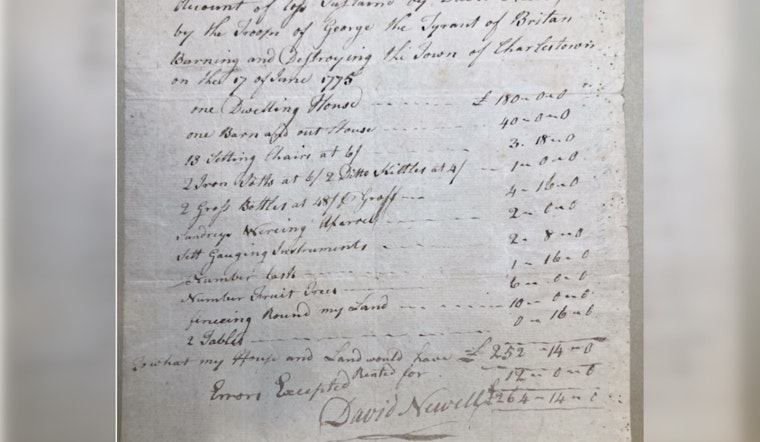
In a noteworthy culmination of nearly two years of meticulous transcription, the City of Boston Archaeology Program has brought to light the forgotten voices of 586 Charlestown residents who filed fire claims following the devastation of the Battle of Bunker Hill in 1776. These handwritten 18th-century documents, once gathering dust, now narrate the staggering losses suffered by families when British troops set fire to the town – a destruction counting a hefty £117,882 in damages.
The in-depth endeavor, spearheaded by the City of Boston Archaeology Program and fueled by a dedicated cadre of volunteers, sought to resurrect the past by painstakingly transcribing each claim. Among these historical remnants was "Account of Loss Sustained by David Newell by the Troops of George the Tyrant of Britain Burning and Destroying the Town of Charlestown on the 17 of June 1775," detailing a loss of £264-14-0. Such documents reveal more than just monetary despair; they offer a tableau of colonial life, showcasing everything from the charred remains of dwellings and personal possessions to impassioned commentary about their British aggressors.
Commencing their journey in November 2023, the team encountered a lead in a Charlestown Cultural Resource Management report that directed them to the Special Collections at the Boston Public Library. There, hundreds of fragile claims were photographed, each folding out tales of tragedy and resilience. Notably, the claims submitted by two free people of color surfaced, shedding light on the realities faced by the 39 known people of color in Charlestown at the time, most of whom were enslaved. "Margaret Thomas, who we believe, was living in Charlestown during the battle," filed for a loss of £68, a sum quite telling of her life's upheaval. From property owner to laundress for General George Washington and beyond, Thomas's journey, like many, faded into obscurity post-1784.
It wasn't just the well-documented who had their stories transcribed. Figures like John Larkin Sr., who's horse is infamously tied to Paul Revere's Midnight Ride, and John Codman Jr., whose tragic family history took a notorious turn, have also had their experiences digitized. The digital compendium isn't merely a ledger of losses; it's a mosaic of the societal fabric at the time of America’s fight for independence.
Despite these thorough documentations of loss, the sad truth resonates that the residents of Charlestown never saw any restitution for their ravaged homes and livelihoods, even after submitting claims repeatedly for over 50 years. For those interested in delving deeper into this chapter of Charlestown's history, the full research and claims can be explored by visiting the City of Boston’s official website.




