

























































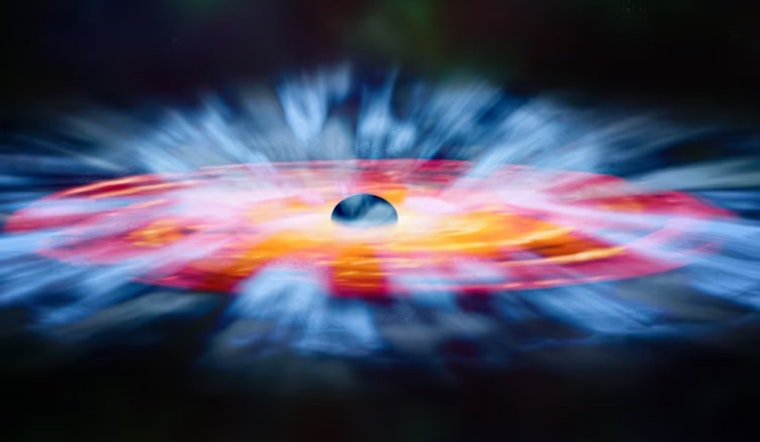
In a recent paper published in the journal Physical Review Letters, an international team of researchers posits that black holes could be the source of dark energy, potentially shedding light on the vexing question of the universe's accelerating expansion. Collapsed dying stars forming supermassive black holes may be emitting this mysterious energy force, challenging previously held notions among physicists and astronomers.
While black holes have traditionally been known as the universe's ultimate sinkholes, absorbing everything in their vicinity, this new theory suggests a different kind of role for them. Discussing the study, University of Cincinnati's Assistant Professor Jessie Muir, a physicist working within an international collaboration on dark energy, told Scientific American via UC News website, "I view this black hole paper as an interesting entry in this growing canon of people testing out, ‘What if I add these physics — does that reconcile these tensions?’" Having not participated in the study, but with expertise in the field, Muir provided a contextual analysis of how the new theory could address existing discrepancies.
The researchers drew upon data from Arizona's Dark Energy Spectroscopic Instrument to develop their theory. This instrument has played a pivotal role in observing the cosmos and probing the nature of dark energy. The paper's findings aim to resolve a longstanding puzzle in Albert Einstein's general relativity theory, which involves the cosmological constant—a value representing the energy density of the vacuum of space—which has thus far eluded precise explanation.
"It is interesting that this can fit the data," Muir mentioned in the conversation with Scientific American regarding the study's potential to reconcile some of the cosmological constant's puzzles. This cautiously optimistic stance hints at how the findings, while preliminary, may shift the perspective on a fundamental force acting upon the universe.
For those intrigued by the vast mysteries of space and the relentless pursuit of knowledge in the face of the unknown, such scientific inquiries represent the cutting edge of cosmological research. The ongoing discourse within the scientific community will no doubt continue to refine, debate, and test these theories in an attempt to unravel the secrets of our ever-expanding universe. For more on this developing story, view the full report in Scientific American via the UC News website.





