

























































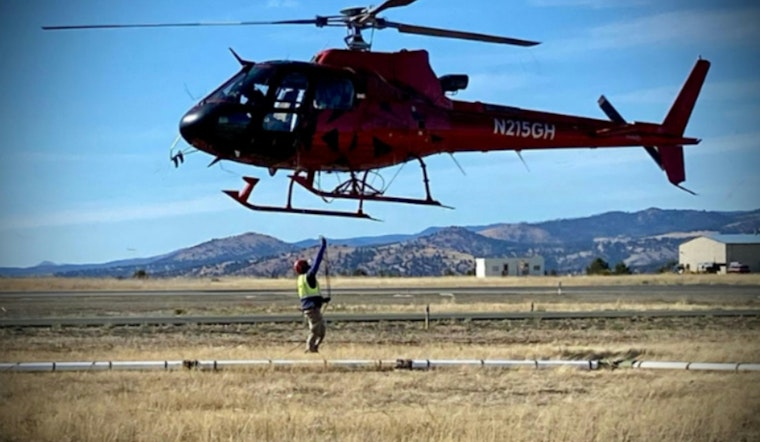
The Grant County Soil and Water Conservation District (GSWCD) is stepping up its game with a new aquifer study that could change the way water is managed in the Upper John Day River Valley. A recent public meeting at the Grant County Regional Airport shed light on the preliminary findings from their high-tech exploration—a study funded by FEMA dollars and steered by the Oregon Department of Emergency Management (OEM). Together with the Bureau of Reclamation (BOR), they're diving deep, quite literally, into the earth's secrets with an airborne electromagnetic survey conducted last month.
Essentially, this survey is like the MRI of the ground, looking for ideal spots to sink water storage wells to secure the valley's future hydration. Flying high, the survey equipment sends an electromagnetic field plunging into the earth, waiting for the silent but telling echo that maps the mysteries below—depths of bedrock, the contours of unseen layers. In the same breath, while navigating hills and trees that could complicate things, LIDAR technology was harnessed to chart a precise topography of the land's surface.
According to the OEM release, the combined data from these surveys will help the GSWCD pinpoint where to drill test wells. These wells will play a crucial role in the experiment to see if water can be saved underground when it's wet so it can be retrieved when the wells run dry—essentially a save now, drink later kind of plan. The technique, known as aquifer storage and recovery (ASR), could be the saving grace for securing water for both local farms and tight-knit communities.
With more erratic rainfall and heightened risks of drought due to climate change, using science to outsmart the elements is becoming increasingly necessary. The commitment to such innovation was echoed by Stephen Richardson, Oregon's mitigation manager. Richardson told attendees at the public presentation that "Projects like this demonstrate how mitigation grant dollars empower local communities to implement science-based solutions that helps them prepare for drought and other climate challenges," as mentioned on the OEM release.



