

























































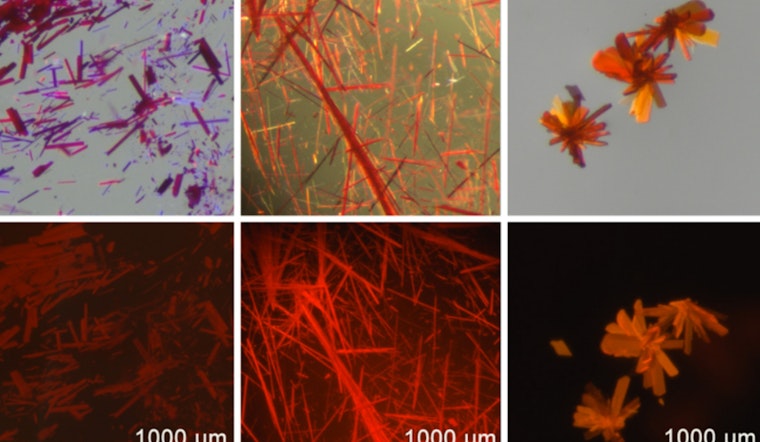
MIT chemists have made a breakthrough in fluorescent molecule design, creating a new dye based on the borenium ion that may significantly improve biomedical imaging with clearer tumor visualization, according to a recent MIT News report. These innovative dyes emit light in the crucial red to near-infrared range, historically a challenge due to instability but now stabilized with the help of ligands for wide-ranging uses from medical diagnostics to temperature sensing.
Lead author Chun-Lin Deng, along with Robert Gilliard, the Novartis Professor of Chemistry at MIT, and their collaborators have been working on the stability issue; their introduction of carbodicarbenes (CDCs) as ligands has allowed for borenium to be handled without the airtight precautions, formerly required and these borenium-containing materials now shine brightly with quantum yields reaching around 30 percent compared to the meager 1 percent of previous red dyes.
The breadth of potential applications for this discovery is expansive, from being encapsulated in polymers for use as injectable imaging dyes to serving as temperature sensors to ensure the safe transport of medications, as Gilliard pointed out in the MIT News release; additionally, these dyes could have future roles in the creation of flexible organic light-emitting diodes (OLEDs) given their environmental stability and strong near-IR emission, making them suitable for smart materials in various high-tech devices.
Gilliard's team is now collaborating with others at MIT and the Broad Institute of MIT and Harvard to explore how these materials function within cells. They aim to further expand the color emission into the deeper near-infrared region, which presents a new challenge of maintaining stability as more boron atoms are incorporated. Yet, these efforts are buoyed by the potential of creating advanced optoelectronic devices and biomedical imaging tools, notwithstanding the insights from Rutgers University's Professor Frieder Jaekle, who was not a part of the study, yet recognized their value as versatile smart materials for fields ranging from bioimaging to anticounterfeiting. Funding for this cutting-edge research comes from the Arnold and Mabel Beckman Foundation and the National Institutes of Health, furthering science's quest in widening our visual and functional access to the inner workings of life and matter.



