

























































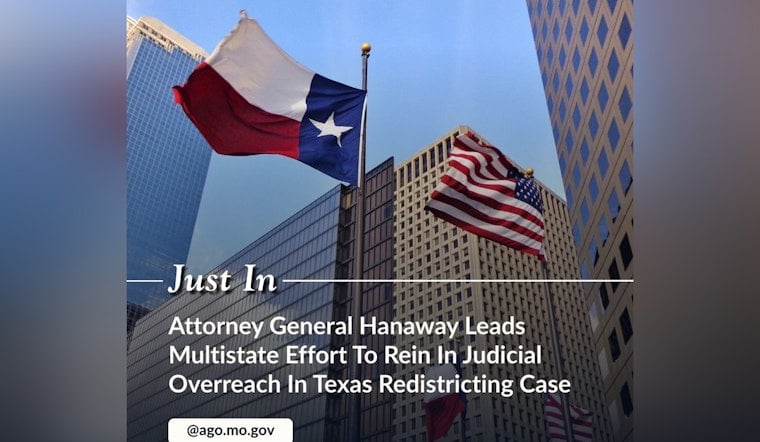
Attorney General Catherine Hanaway of Missouri has spearheaded a multistate legal move, filing an amicus brief with the U.S. Supreme Court in a bid to halt what is perceived as judicial overreach in a Texas redistricting dispute, an action supported by twenty-one states as reported by the Missouri Attorney General's Office. The brief insists that a federal district court bypassed protocol when it nullified Texas's congressional map granting five additional seats to the opposing party. "Redistricting is a duty entrusted to the people’s elected representatives," Hanaway stated, emphasizing the prerogative of state legislatures over partisan litigation.
The coalition of states is firmly backing Hanaway's stance, which is based on the belief that the district court disregarded a key Supreme Court precedent set in 2024's Alexander v. South Carolina State Conference of the NAACP, that those asserting racial gerrymandering must provide an alternative map, one that meets the state's political objectives without escalating to racial bias claims. The plaintiffs in Texas failed to offer such a map, despite having the technological capacity to generate multiple alternatives swiftly, and yet they succeeded in having an outdated map reinstated which coincidentally favored their political faction. Missouri's interest in this case arises not only in solidarity but also from self-preservation, as it faces its challenges from external entities that push to overturn its congressional map.
In her defense, Hanaway articulates a principle that is at stake, which is the separation of powers, and the necessity to keep redistricting within legislative bounds as any intrusion by unelected judges can pose a threat to the electoral integrity of all states. "Just as Missouri is defending our own map from outside interference," Hanaway proclaimed, "we are standing with Texas to protect the constitutional line between courts and legislatures." The Missouri Attorney General's Office has evidently rallied the support of counterparts from Alabama to West Virginia, all of whom agree that the Supreme Court must intervene to ensure that Texas retains control of its redistricting process for the upcoming 2026 congressional map.





