

























































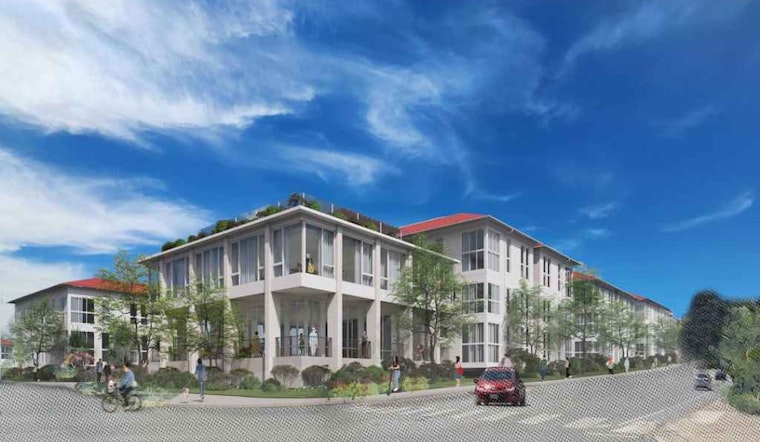
The Presidio is about to break a 20-year development drought with its most ambitious housing project since the Letterman Digital Arts Center opened in 2005. The federal park entity has unveiled plans for a 196-unit apartment complex that will transform a parking lot and two aging 1970s buildings into a revenue-generating residential campus designed to keep the national park financially self-sufficient.
The timing couldn't be more critical. Back in February, President Trump issued an executive order targeting the Presidio Trust for elimination, declaring it an example of "waste and abuse." Though the Trust successfully defended its existence by highlighting its financial self-sufficiency—it hasn't taken annual appropriations from Congress since 2013—the political threat underscored the urgent need to maximize revenue streams.
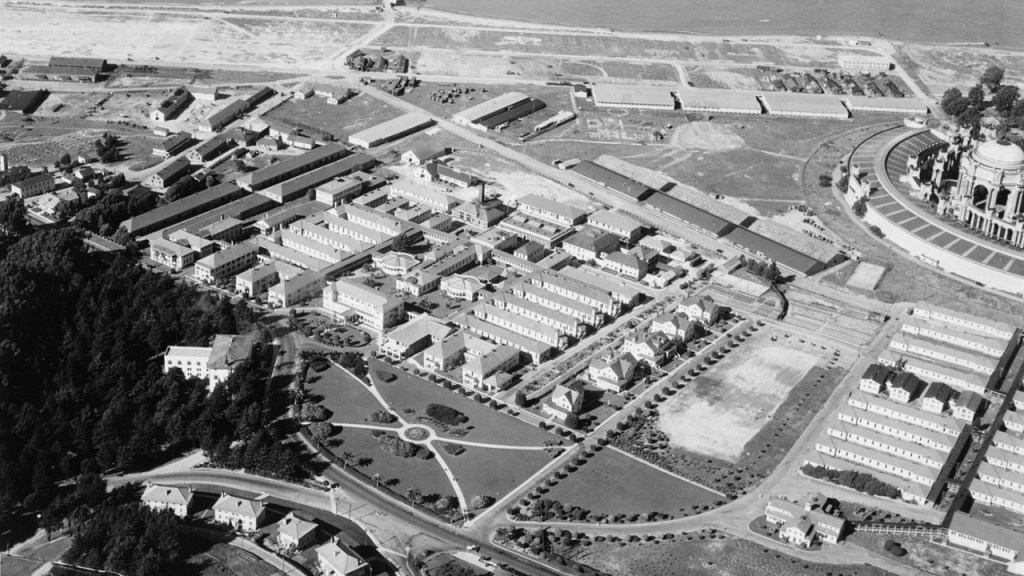
Letterman General Hospital, 1926 (Originally built 1898) - Source: Presidio Trust
A National Park That Pays Its Own Way
"It's really, really important we maximize the real estate to the best extent we can," Joshua Bagley, deputy chief business officer for the Presidio Trust, told the San Francisco Chronicle. The project "will be a significant boost to our revenue." Currently, the Presidio's 1,400 housing units generate about 35% of the park's operating budget, with the complex operating at more than 97% occupancy, according to the Chronicle.
The new development will sit at the intersection of Lincoln Boulevard and Girard Road, on 4.6 acres within the 60-acre district once occupied by the Army's Letterman General Hospital. The hospital, first established in 1898, was at one point the densest part of the military base and the second-largest military hospital in the U.S. during World War II, as reported by The Real Deal.
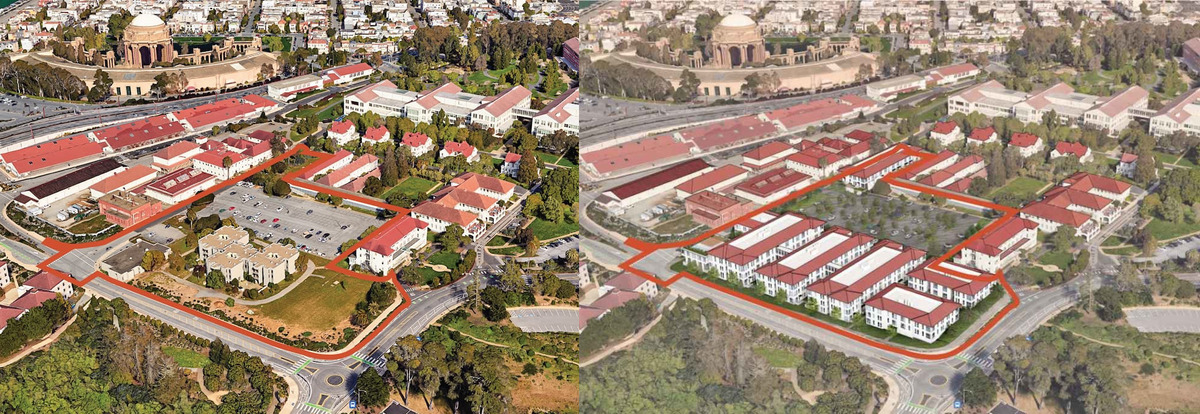
Proposed Development Area (Left Current) - Source: Presidio Trust
Filling a Critical Housing Gap
While the Presidio is home to 3,000 residents, there's a glaring mismatch in unit sizes. About 75% of existing apartments have at least three bedrooms, with some boasting five or six bedrooms, the Chronicle reported. The new complex will address this gap with mostly studios, one-bedrooms, and two-bedrooms spread across six buildings.
"We think it will give us an opportunity to diversify the portfolio with more housing, and we think it will create a more inviting park experience while helping to restore a key historic district in the Presidio that is not quite in the same condition as other parts of the Presidio," Bagley told the Chronicle.
A Rare Development Advantage
The project arrives at a moment when Mayor Lurie's ambitious "family zoning" plan is facing criticism for falling far short of the city's housing goals, with a City Economist report forecasting it would only produce 40% of the 82,000 units required by 2031. Meanwhile, market-rate housing development across San Francisco has largely stalled due to high construction costs and scarce equity capital.
The Presidio Trust, however, operates with a unique advantage: it can borrow directly from the U.S. Treasury and develop without private partners using Trust equity. According to the Chronicle, this makes it one of the few entities in the city currently able to move forward with new construction. "This will be the first opportunity for the Presidio Trust to be the developer on a new construction site," Bagley said. "While we will take all the development risk, that means we will also be rewarded with all the upside."
Historic Design Meets Modern Needs
The six buildings will be two and three stories tall, designed by David Baker Architects to evoke the Presidio's historic architecture without directly mimicking it. Daniel Simons, a partner with the firm, explained to the Chronicle that the design takes inspiration from the park's utilitarian military buildings—wooden walk-ups with peaked roofs and the Presidio's signature white and gray lap siding.
"With a lot of those buildings, they were not thinking about designing architectural masterpieces," Simons said, as reported by the Chronicle. "They were very utilitarian buildings. They were very simple. They were straightforward." The complex will emphasize outdoor connections with meandering paths, exterior stairs, and what Simons calls "moments of discovery"—design elements intended to create a campus feel rather than a single monolithic structure.
David Baker Architects has built a reputation for exactly this kind of work. The firm has spent more than 35 years designing affordable and workforce housing across the Bay Area, earning the title of firm of the year from the American Institute of Architects, California Council.
The Path Forward
The Presidio Trust published its "notice of intent" to begin the environmental review process on November 3. A public meeting is scheduled for November 18 at 6 p.m. at the Presidio Officers' Club, located at 50 Moraga Avenue, according to information on the Presidio Trust website. The public comment period runs through December 8, 2025.
Construction is expected to break ground in 2027, The Real Deal reported. The project will add approximately 160,000 square feet of new residential space, replacing two non-historic structures—one vacant, the other currently used by U.S. Park Police for evidence storage, according to the Chronicle.
Revenue for the Park's Future
The development represents more than just housing—it's a financial lifeline for maintaining the Presidio's status as a fee-free national park. The Trust achieved record earned operating revenue of $182 million in 2024, validating its self-sustaining business model, according to a February 2025 press release. All of the Trust's $58 million net operating income is reinvested into the park.
"If people love the Presidio, they will love this project because it will add more housing, repair a key historic district and generate the revenue necessary to meet our park goals of delivering a beautiful, safe and clean park with no entrance fees, forever," Bagley told the Chronicle.
The conceptual plan has roots stretching back to Presidio plans from 2000 and 2007, which called for "removal and replacement of non-historic housing in previously developed areas west of the historic complex, to provide more compatible residential structures close to work sites," according to the Chronicle. Now, more than two decades later, that vision is finally moving toward reality.





