

























































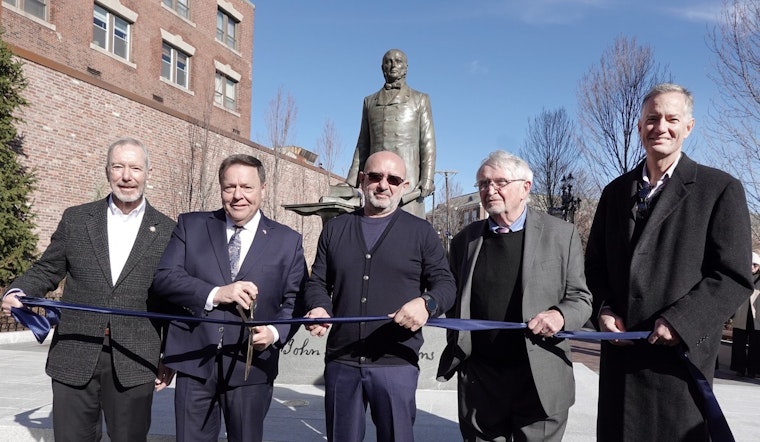
The City of Quincy has recently celebrated its deep-rooted connection to American presidential lineage with the inauguration of a park dedicated to former President John Quincy Adams. This new civic space, unveiled in the hub of Quincy Center, sits as a testament to a past leader's historical significance, as reported by Boston 25 News. The city's leaders, in a move replete with ceremony, introduced to the public a realm that features four bronze panels, each a narrative relief recounting President Adams's key life moments, like his pivotal role in concluding the War of 1812 with the Treaty of Ghent.
The park also boasts a statue of the sixth president by Sergey Eylanbekov, an artist with a knack for commemorating Quincy's historical titans, his portfolio already inclusive of John Hancock, Abigail Adams, and John Adams, according to The Boston Globe. Bronze reliefs interspersed around, recapture the tenure of Adams's presidency, his diplomatic triumphs, his influence on the Monroe Doctrine, and his later advocacy against the institution of slavery as "Old Man Eloquent" within the halls of Congress.
At the park's debut, Quincy Mayor Thomas Koch spoke of the dedication as an extension of the community's embrace of its presidential roots, revealing how figures such as John Quincy Adams once traversed these same grounds. "That's who we are," he told the assemblage, conveying a sentiment of shared heritage. Edward Fitzgerald, quoted by The Boston Globe, remarked on Adams’s overdue public homage and his status as a bridge from the Revolutionary generation to the burgeoning American nation.
Eylanbekov's sculpture conveys Adams's intellect and steadfast nature, featuring Adams beside a table of books, mirroring his reputation for erudition and eloquence, and dressed in the simpler fashion of his time—symbolic of his character, the sculptor eschewed the more lavish knee-breeches common in the 18th century for understated trousers, which well suit the man's fabled modesty. Local residents, chancing upon the greenery amidst Quincy's burgeoning urban landscape, welcomed the park; some, like Randy Luddington, reveled in Adams's moral fortitude against slavery, while others, like Jay Stearns, find the park's green a fitting balance to the city's development fervor.
The significance of the park resonates personally for young Abigail Houghton, who shared with The Boston Globe that as a direct descendant of the Adams legacy, she feels the statue of John Quincy Adams symbolically watching over America's future, especially in Quincy. Houghton emphasized the inspiration she draws from her family's historical ties and the potential for impact that heritage imparts to her own ambitions.





