

























































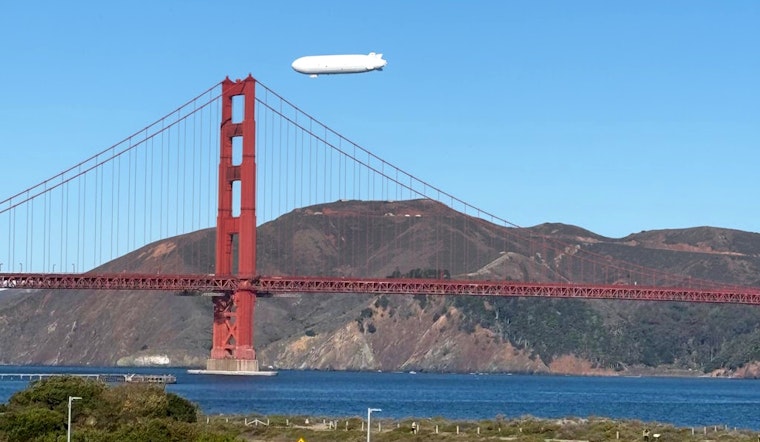
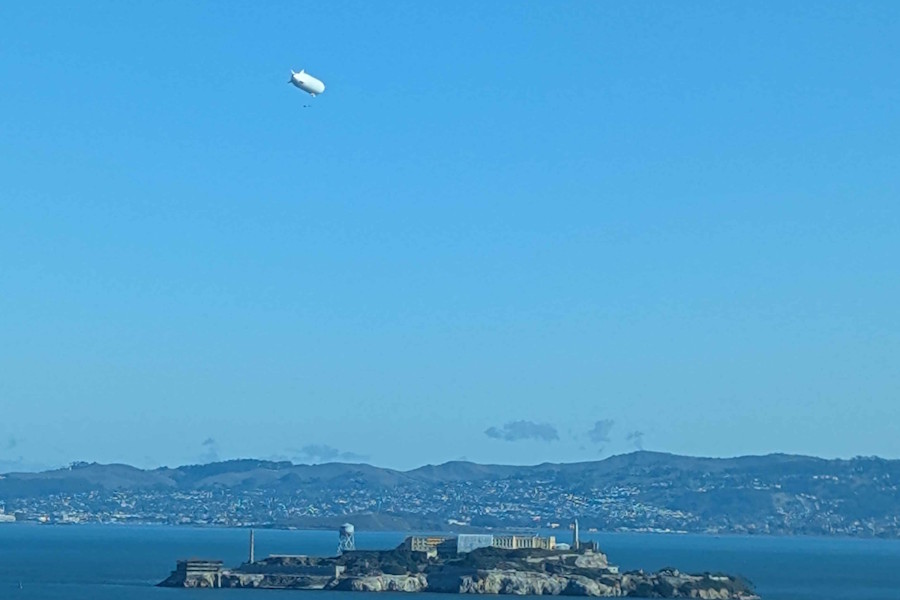
The Bay Area's skies are once again home to a remarkable sight—a massive white airship silently gliding over iconic landmarks, from the Golden Gate Bridge to Alcatraz and beyond. Hoodline SF staff witnessed and photographed the 400-foot behemoth as it traced a deliberate path across San Francisco's most famous vistas, marking another milestone in what could be aviation's most ambitious eco-friendly experiment.
The craft in question is Pathfinder 1, the rigid airship developed by LTA Research & Exploration, a company backed by Google co-founder Sergey Brin. At 124 meters long—roughly the length of three Boeing 737s lined up nose to tail—it's currently the world's largest aircraft, dwarfing even the familiar Goodyear blimp that occasionally graces sporting events.
A Silicon Valley Giant Takes Flight
The airship's recent journey from its home base at Moffett Federal Airfield in Mountain View to the Golden Gate represents more than just a test flight. According to AeroTime, the Federal Aviation Administration's renewal of Pathfinder 1's Special Airworthiness Certificate has expanded its operational envelope, allowing flights over previously restricted urban areas.
"Today's flight took us north to San Francisco—another step in demonstrating stable, controlled operations in the San Francisco Bay Area," LTA Research stated on LinkedIn, as reported by KRON4. The company noted that flying over the Golden Gate Bridge provided crucial data about the airship's performance in the unique wind patterns and maritime conditions characteristic of the Golden Gate Strait.
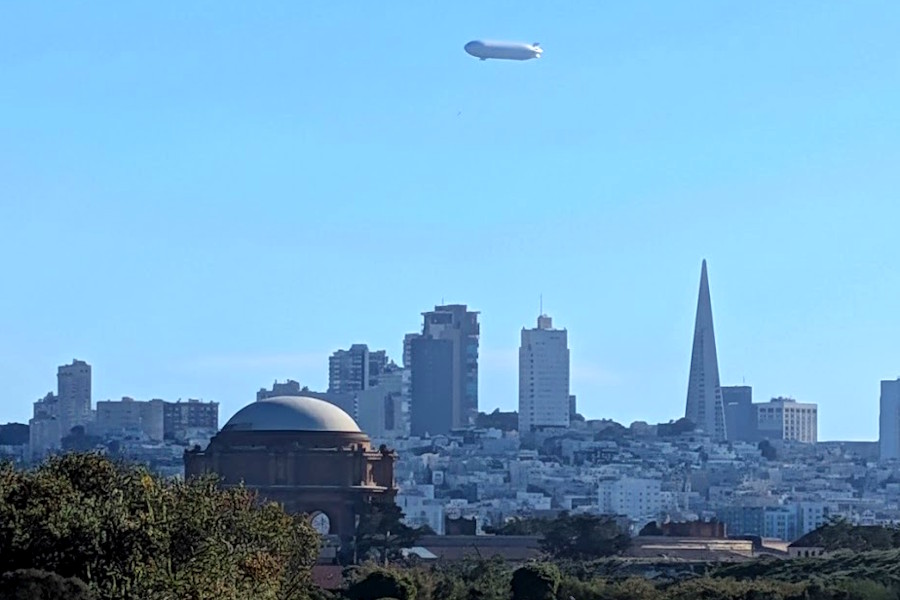
This isn't your grandfather's blimp. Unlike the soft-bodied advertising airships we're accustomed to seeing, Pathfinder 1 features a rigid internal framework of 3,000 welded titanium hubs and 10,000 carbon fiber tubes—engineering that, according to IEEE Spectrum, makes it light enough to use non-flammable helium instead of the hydrogen that doomed the Hindenburg.
From Tech Hub to Humanitarian Mission
While Bay Area residents might see this as another quirky tech billionaire project floating overhead, Brin's ambitions extend far beyond creating what some have dubbed an "air yacht." The airship is designed with humanitarian disaster relief at its core—a mission that became personal for Brin after he used his superyacht to deploy medical personnel following a cyclone in the South Pacific.
LTA Research operates in tandem with Global Support and Development (GSD), a disaster relief organization that The Daily Beast revealed was founded by Brin. The organization, which employs many former military personnel, focuses on rapid response within the first 24 to 96 hours following disasters—precisely when traditional infrastructure often fails.
The appeal is obvious: airships don't need runways, can hover in place for loading and unloading, and can reach areas where roads are destroyed or never existed. As The Brighter Side notes, current options for moving heavy equipment to disaster zones often require building temporary roads at costs exceeding $5 million per kilometer.
The Electric Revolution Above
Pathfinder 1's twelve electric motors, developed with Pipistrel, can rotate 360 degrees for precise control and vertical takeoff and landing capabilities. The current hybrid system uses diesel generators alongside batteries, but LTA has bigger plans. According to Yahoo Finance, the company is developing a 1.5-megawatt hydrogen fuel cell system that would make future airships completely emission-free.
The environmental implications are substantial. Industry estimates suggest airships could reduce carbon emissions by 80-90% compared to conventional aircraft for cargo transport. For perspective, that's the difference between a Tesla and a diesel truck, but in the sky.
Building on Bay Area Aviation Heritage
There's poetry in Pathfinder 1 calling Moffett Field home. The airfield was originally built in the 1930s specifically to house the USS Macon, one of the U.S. Navy's massive rigid airships. Now, nearly a century later, Hangar 2 at Moffett shelters what could be the first of a new generation of lighter-than-air craft.
The progression doesn't stop here. LTA Research has already acquired the former Goodyear Airdock in Akron, Ohio—the world's largest airship hangar—where they're planning Pathfinder 3, a 590-foot monster capable of carrying 96 metric tons with a range of nearly 10,000 miles.
Local Impact and Public Fascination
Social media lit up during recent sightings, with one Twitter user joking about "drones on the east coast, blimps in San Francisco," while NBC Bay Area's Raj Mathai captured the craft returning to Moffett Field. The SFist tracked the airship reaching speeds of 35 mph—not exactly "hauling ass" by jet standards, but surprisingly quick for something that looks like it should be advertising tires at a football game.
For Silicon Valley commuters on Highway 101, the sight has become almost routine, though no less remarkable. Some have reported traffic slowdowns as drivers crane their necks to watch the massive craft drift overhead—a very Bay Area traffic jam if there ever was one.
The Challenges Ahead
Not everyone's convinced airships will revolutionize transportation. Critics point to their vulnerability to weather, relatively slow speeds (even at maximum velocity, Pathfinder 1 tops out around 75 mph), and the limited global supply of helium. There's also the psychological hurdle—mention "hydrogen airship" to most people, and they immediately think Hindenburg, despite modern safety advances.
Yet the potential applications keep expanding. Beyond disaster relief, companies worldwide are exploring airships for everything from wind turbine installation in remote locations to carbon-neutral cargo transport. Aeros Corporation claims their 66-ton capacity airship could remove 400 trucks from roads, while Happy Eco News reports that Flying Whales' planned electric cargo airship could transform renewable energy infrastructure development.
Looking Forward
The timing of Pathfinder 1's expanded flight testing feels particularly relevant. As California grapples with increasingly severe wildfire seasons, atmospheric rivers, and other climate-related disasters, the promise of rapid, infrastructure-independent disaster response takes on new urgency.
LTA CEO Alan Weston told TechCrunch he's "excited about the potential of not building just one airship, but laying the foundation for many airships to be built." He acknowledges airships won't replace conventional aircraft but sees them filling crucial niches in transportation architecture while reducing aviation's carbon footprint.
For now, Bay Area residents can expect to see more of these gentle giants overhead as testing continues. Each flight brings LTA closer to their goal of commercial certification and, ultimately, a fleet of zero-emission airships serving both humanitarian and commercial purposes. It's a vision that seems simultaneously futuristic and nostalgic—very much in keeping with Silicon Valley's tendency to reimagine old ideas with new technology.
Whether Pathfinder 1 represents the future of sustainable aviation or simply another ambitious tech experiment remains to be seen. But for those lucky enough to spot it drifting silently over the Golden Gate, it's hard not to feel you're witnessing something significant—a possible turning point where the romance of early aviation meets the urgent needs of our climate-conscious present.
The next time you see that massive white shape floating above San Francisco Bay, remember: you're not just looking at Sergey Brin's latest project. You're potentially glimpsing a solution to some of our most pressing logistical and environmental challenges, wrapped in 400 feet of cutting-edge engineering and century-old dreams of lighter-than-air flight.





