

























































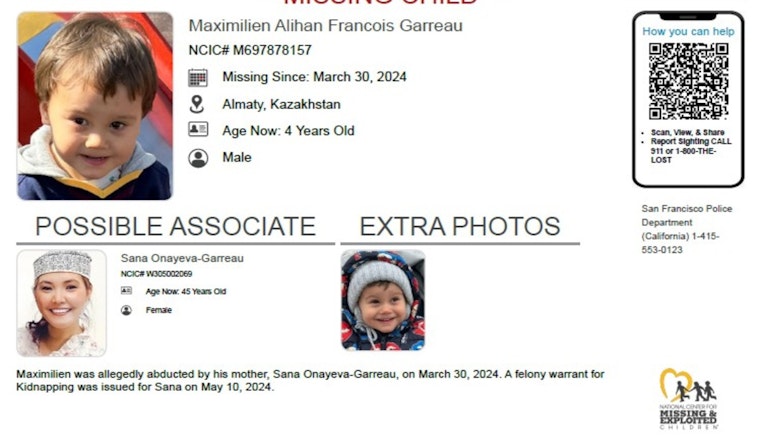
A San Francisco family-court travel order has spiraled into an international missing-persons case — and a rallying point for critics who say the bench lacks oversight. The child’s father, Guillaume Garreau, says he was awarded sole custody after a judge found his ex-wife committed domestic abuse, but a later judge granted a travel order and the boy was taken abroad. The fallout has fueled new complaints and fresh scrutiny of how family judges are trained and reassigned in San Francisco.
How The Case Moved Through SF Family Court
As reported by The San Francisco Standard, Garreau filed for separation and a domestic-violence restraining order in February 2023. Judge Daniel Flores later found that Sana Onayeva had committed domestic abuse, awarding Garreau sole legal and physical custody. The case was then reassigned to Judge Michelle Tong, who, after an initial denial, granted Onayeva permission to travel in February 2024. Onayeva left for Kazakhstan with the couple’s son — Maximilien — in mid-March 2024 and did not return. Onayeva was later charged in the United States with child abduction and contempt of court, and Garreau says he has spent hundreds of thousands of dollars on litigation and searches to bring his son home.
Missing Poster And A U.S. Warrant
The National Center for Missing & Exploited Children lists Maximilien Alihan Francois Garreau as missing from Almaty, Kazakhstan (NCIC# M697878157) and shows a felony warrant for Sana Onayeva-Garreau (NCIC# W305002069), noting the child was reported missing in late March 2024. The poster includes contact information for the San Francisco Police Department, and the case remains an open investigation.
What Kazakhstan’s Courts Have Said
Kazakh reporting says juvenile courts in Almaty ordered Maximilien returned to the United States in January 2025 and that a cassation court later affirmed the decision. It also reports that Kazakh authorities placed Onayeva and the child on a search list and that Interpol notices were sought. Orda.kz and Garreau’s legal team say the father’s search trips and local investigations have so far been unable to locate the boy.
Why The Bench Is Under The Microscope
The Standard’s review of court records and commission data found that San Francisco family court drew more complaints than any other judicial division and that the state commission investigates only a small fraction of filings — a dynamic critics say leaves major decisions with little public scrutiny. As The San Francisco Standard reported, litigants and attorneys described reassignment practices and the use of peremptory challenges that can leave less-experienced judges presiding over complex domestic-violence and custody disputes.
What’s Next — And The Legal Limits
Prosecutors and attorneys say the case highlights the limits of both criminal and civil tools: prosecutors can seek warrants and work with foreign authorities, but there’s no straightforward way to compel a child’s return from a country that does not participate in the Hague Abduction Convention. The Daily Journal reported that the district attorney’s office has disqualified judges from certain calendars when fairness is in question, a practice that has heightened tensions between the DA and the bench as litigants pursue appeals and complaints in multiple forums.
For Garreau, it remains a personal search for a child he says he legally won custody of. For local lawyers and judges, it’s a case study in how a single travel order can expose gaps in training, transparency, and enforcement across family court systems. Whether that spurs policy or disciplinary changes — at the court, the state commission, or in how judges are assigned — will be closely watched by litigants and advocates on both sides of the bench.





