

























































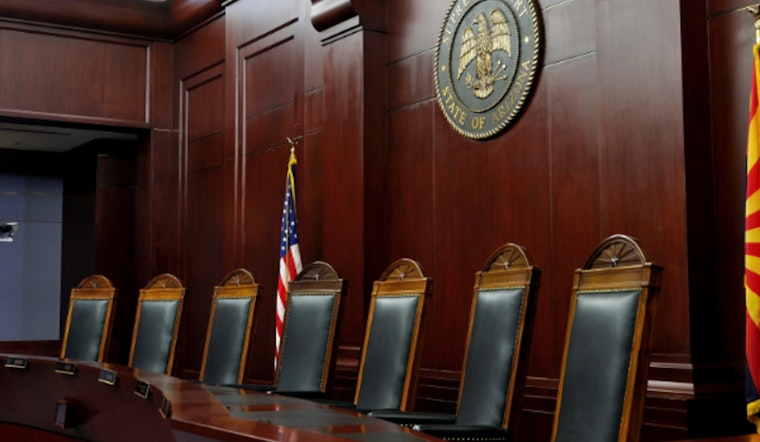
The Arizona Supreme Court has recently made a pivotal decision in the case of State v. Gregory James Owen, concerning the interpretation of the state's traffic laws, particularly the red-light statute A.R.S. § 28-645(A)(3)(a) and the enhanced penalty statute A.R.S. § 28-672(A), linked to traffic offenses resulting in serious injury or death. This ruling comes after an incident with fatal consequences in Lake Havasu City, where Owen was implicated in a crash that resulted in a death.
In the incident, Owen failed to stop for a red light and rear-ended a Jeep Grand Cherokee, which propelled both vehicles into the intersection while the light was still red, leading to the passenger's death in the Jeep; however, the question that persisted throughout the trial pertained to the applicability of the enhanced penalty statute, considering whether the fatal accident took place before Owen technically committed a red-light violation, as his car had not yet entered the intersection, and this uncertainty cascaded through lower courts as they wrestled with the statute's interpretation.
A definite conclusion was reached by the Arizona Supreme Court, with Justice William G. Montgomery stating, "a red-light violation occurs only when a vehicle enters an intersection against a steady red signal." Consequently, the Court determined that for the enhanced penalty to apply, the traffic violation needs to precede the accident, which was not the case for Owen, therefore the enhanced penalty statute was deemed inapplicable by the Court.
The Supreme Court's verdict overturned the Court of Appeals' previous opinion which had reinstated Owen's conviction, and they affirmed the Superior Court's order which reversed Owen's conviction, directing an acquittal instead and this decision adds clarity to the conditions under which these statutes will be applied in future cases that involve the grave outcomes of civil traffic violations. Dissent in the case was put forth by Justices Clint Bolick and John Pelander (Ret.). The outcome of this decision has likely set a precedent that will influence how similar cases are approached in Arizona's judicial system.





