

























































Kauaʻi’s new coral restoration nursery at Nōmilu Fishpond has officially taken in its first “corals of opportunity,” giving the island a homegrown hub for reef repair. The rescued fragments are being cut into tiny micro pieces, fixed onto concrete modules and cared for at the on-shore facility until they grow into larger colonies ready for outplanting. It is the first time Kauaʻi has had a dedicated, on-island nursery focused on scaling up coral restoration.
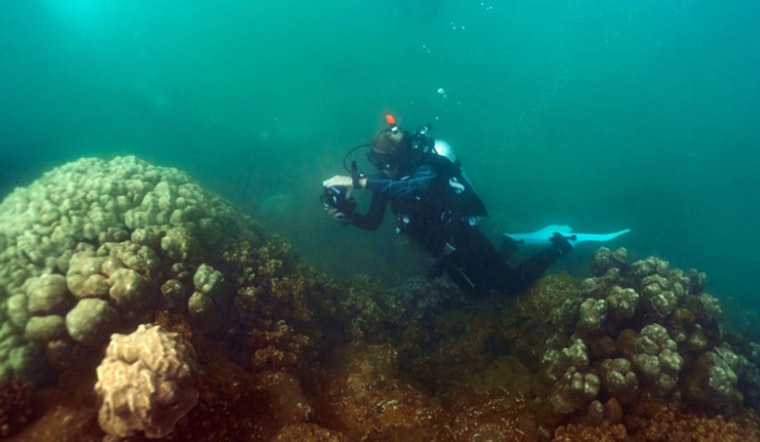
According to a news release from the Hawaiʻi Department of Land and Natural Resources, the initial collection took place earlier this month, led by Hoʻomalu Ke Kai in collaboration with Kauaʻi Ocean Awareness, Kauaʻi Sea Farm, the DLNR Division of Aquatic Resources and the University of Hawaiʻi Coral Resilience Lab. The release notes that the nursery is intended to boost local capacity for reef restoration and emergency response, supplying trained staff and healthy source colonies for projects across the island. Media materials from the state show team members carefully photographing each coral in place before removing it from the reef.
What Was Collected
The team recovered two familiar Hawaiian reef builders: Montipora capitata (rice coral) and Porites lobata (yellow lobed coral). These “corals of opportunity” are loose or damaged colonies salvaged from storms, groundings or anchor damage. They are being trimmed into fragments roughly 1 to 3 cm² in size, then attached to pyramid-shaped cement modules. The pieces are spaced so they can grow along their living edges and eventually fuse into colonies about 30 cm by 30 cm, as reported by Maui Now.
How The Nursery Speeds Growth
The project adapts a rapid growth protocol developed at the DAR Hawaiʻi Coral Restoration Nursery on Oʻahu, and the Kauaʻi team plans to work closely with that Oʻahu group to fine tune the method for local reefs, according to the state release. Research published in PeerJ shows that microfragmentation and module based nurseries increase the proportion of living edge on each fragment, which helps pieces fuse more quickly than they would under natural growth alone. By producing many small fragments and encouraging them to merge, practitioners can grow restoration scale colonies faster while still maintaining genetic diversity.
Why This Matters For Kauaʻi Reefs
Reef building corals in Hawaiʻi tend to grow more slowly than many tropical counterparts, so recovery from damage can take years without help. Recent severe bleaching events and other warming driven stressors have added extra pressure on island reefs, a trend that NOAA Fisheries continues to track. Organizers also point to the nursery’s workforce angle. Community partners aim to pair hands-on restoration with training and certification for local scientific divers and reef technicians to support long term stewardship, according to Hoʻomalu Ke Kai.
For now, partners say the priority is to stabilize and grow the salvaged fragments while refining protocols with the Oʻahu nursery team before ramping up production for outplanting and wider reef recovery work, as reported by Maui Now. Community restoration days and volunteer opportunities are expected to factor in as the nursery scales up and more “reef patients” check out of the coral ER and back into the ocean.





