

























































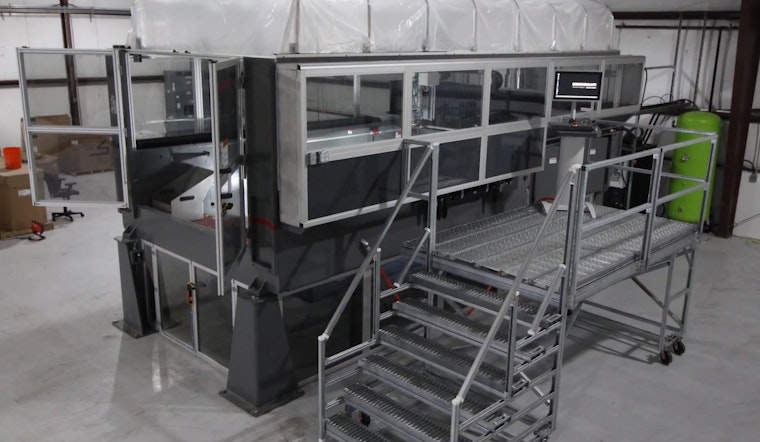
Emerging from the Department of Energy's Oak Ridge National Laboratory, a new player in the industrial printing world has made its mark. Additive Engineering Solutions, an Ohio-based company, has taken giant strides in large-format 3D printing, a field that they entered inspired by ORNL's work. The original spark for this venture was a 2014 event where ORNL and partners 3D printed a car on the show floor of the International Manufacturing Technology Show, capturing the attention of engineer Austin Schmidt. As Schmidt later began to explore larger polymer prints at ORNL, he confronted a supply-and-demand dilemma. "I like to say, ‘Oak Ridge National Laboratory’s MDF will print one part for anyone, but two parts for no one,'" Schmidt told ORNL news.
Addressing this gap, Schmidt decided to possibly create a company that could regularly offer large-format 3D prints. He teamed up with Andrew Bader, an associate with family ties in the metalworking industry. Together, they worked to purchase a big area additive manufacturing printer, developed in cooperation with ORNL, big enough to potentially host a small dinner party inside. Transitioning from laser cutting to polymer extrusion, they faced learning curves in adapting the "Slicer" software – essential for dictating the printer's actions during layer formation – to their new AVAM system. "The Slicer software program takes an object, ‘slices’ it into layers, then fits toolpaths to each layer," explained Alex Roschli, ORNL lead software engineer for Slicer, in a statement obtained by ORNL news.
In their journey, AES has had to overcome technical challenges such as the "Goldilocks" problem of maintaining the precise temperature needed for successful printing. "The printing can't be too hot or cold, or we end up scrapping the whole job," Schmidt explained to ORNL news. To address this, they've experimented with changing the nozzle's angle, which in turn necessitated intricate new software instructions.
Gradually taking over the BAAM market, AES can boast ownership of four out of 15 max BAAMs ever produced. As Cincinnati Inc. ceases production of these printers, AES has grown to become a vital support hub for others in the industry. With newly broken ground on factory space, AES highlights the importance of ORNL's support. "It wasn't just that they showed us how to use the machine, they pulled together the whole ecosystem needed to make it successful," Schmidt told ORNL news. AES's services are now sought after in various industries, from aerospace to construction, demonstrating the expanding niche of large-scale polymer 3D printing.





