

























































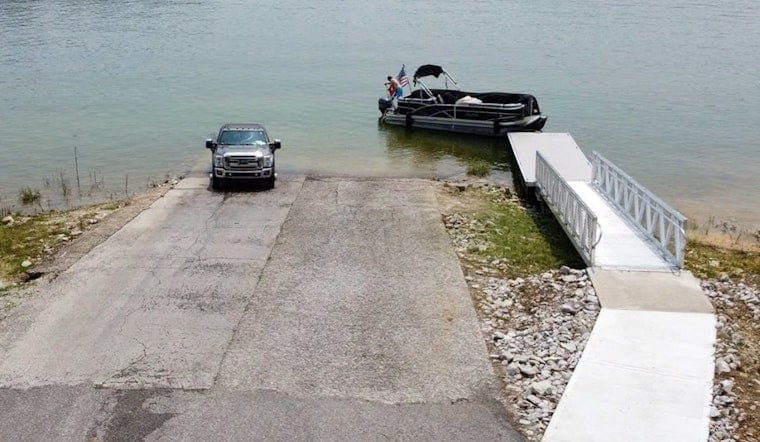
A new floating dock has opened at the Davis Cemetery Access Area on the Campbell County side of Norris Lake, and it's the first courtesy dock in that stretch of the lake built to accommodate wheelchair users. The project, developed through a partnership between the Tennessee Wildlife Resources Agency and Campbell County, gives anglers who use wheelchairs a direct path to the water for the first time on that shoreline. It also expands public access to a lake that stretches across five East Tennessee counties.
The completed dock was announced in a Tennessee Wildlife Resources Agency Facebook post sharing photos of the new structure. The full project cost $100,000, according to TN.gov, with $75,000 coming from a federal Sportfish Restoration grant administered by TWRA and the remaining $25,000 covered by a Campbell County match.
Years Of County Advocacy Behind The Project
The dock represents years of planning that started under former 1st District Commissioner Robert Higginbotham and was carried to completion under 3rd District Commissioner Rusty Orick, Campbell County's liaison to TWRA, as reported by WIVK-FM. The station notes that prior public docks on the Campbell County side of Norris Lake lacked dedicated wheelchair access, making this the first structure of its kind in that part of the lake.
Norris Lake itself was created in 1936 by the Tennessee Valley Authority and now covers 33,840 acres of water with more than 800 miles of shoreline across Anderson, Campbell, Claiborne, Grainger and Union counties, according to Cumberland Gap Tourism. That scale is part of why a single new access point can matter well beyond one county line.
A Bigger Moment For Norris Lake Fishing
The lake's fishing profile is also on the rise nationally. Norris Lake was selected to host Stage 3 of the 2027 Major League Fishing Bass Pro Tour set for March 2027, marking the first time the national pro bass circuit will compete there, per Claiborne Progress. Campbell County and its Chamber of Commerce are expected to serve as local hosts for that event.
The new dock also fits into a larger state effort. Norris Lake is designated under Tennessee's Bill Dance Signature Lakes initiative, a multi-agency program launched in 2021 to standardize and upgrade public fishing access across 18 lakes statewide, according to the Tennessee Department of Tourist Development. The initiative involves TWRA, the Tennessee Department of Environment and Conservation, and the tourism department working together on shared upgrades.
State wildlife and tourism data estimate Norris Lake draws roughly 67,687 angler trips a year, generating more than $1.5 million in direct economic impact for the surrounding region, according to the Bill Dance Signature Lakes program page. The lake supports largemouth bass, smallmouth bass, walleye and crappie, among other game species.
Engineering For A Lake That Rises And Falls
Building an ADA-compliant dock on Norris Lake comes with its own engineering challenge, since the reservoir isn't a static body of water. The Tennessee Valley Authority manages seasonal drawdowns of 29 to 45 feet on Norris Reservoir, dropping water from summer pool levels after Labor Day to minimum flood-control levels by January, according to Alco Builders and Realty. A floating structure is built to rise and fall with the shoreline rather than leave wheelchair users stranded on dry ground once the lake drops.
TWRA's engineering and fisheries divisions maintain dedicated statewide programs to design and build ADA-accessible fishing piers, gangways and courtesy docks across Tennessee's public waterways, and the agency keeps online maps of its barrier-free hunting and fishing sites. The Davis Cemetery Access Area dock adds one more stop to that map for Campbell County.
The dock's federal funding came through the Sport Fish Restoration Program, created under the Dingell-Johnson/Wallop-Breaux Act, which generates roughly $450 million a year nationally through excise taxes on fishing tackle, motorboat fuel and other boating gear, according to TN.gov. Those federal dollars are distributed to state wildlife agencies such as TWRA based on land area and the number of licensed anglers, illustrating how a modest local match from Campbell County was able to unlock a much larger pool of federal money for the project.





