

























































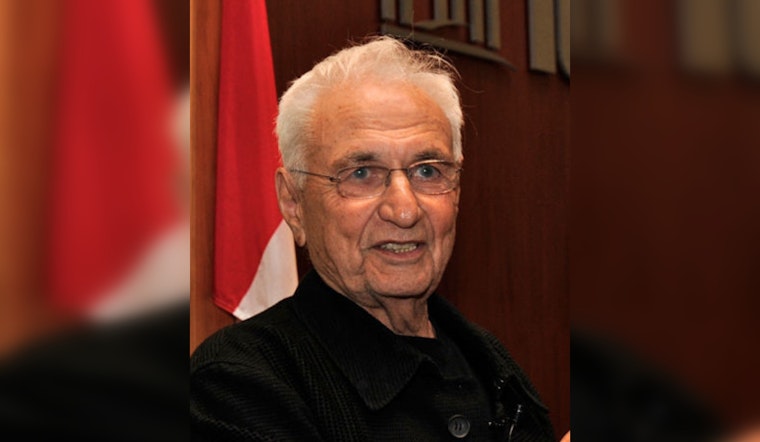
Frank Gehry, the architect whose stainless steel ribbons helped define Millennium Park’s Jay Pritzker Pavilion and who built landmarks from Bilbao to Los Angeles, died Friday at 96. His daring, sculptural buildings reshaped how cities talk about architecture and turned the Pritzker Pavilion into a must-see stop on Chicago’s lakefront. His career stretched more than six decades and left an outsized imprint on public space around the world.
Gehry’s death was confirmed by his firm and reported by major outlets. He died at his home in Santa Monica after what officials described as a brief respiratory illness, according to The Associated Press. Meaghan Lloyd, chief of staff at Gehry Partners, has been named in coverage as the person who confirmed the news. Funeral arrangements had not been announced as of Friday, Crain's Chicago Business reported.
Gehry's Chicago landmark
The Jay Pritzker Pavilion, Gehry’s stainless steel bandshell at the center of Millennium Park, opened in 2004 and now anchors the park’s summer season of free concerts and the Grant Park Music Festival. Its proscenium and overhead trellis were engineered to deliver indoor-quality acoustics across the Great Lawn, turning what could have been just another outdoor stage into something closer to a concert hall under the open sky.
The pavilion’s design was officially classified as a work of art to comply with long-standing Grant Park rules, according to the Chicago Architecture Center. That legal distinction helped clear the way for the swooping, metallic forms that now frame countless summer selfies and symphonies.
A career of curves and computation
Gehry rose to international prominence with the Guggenheim Museum Bilbao, the 1997 project often credited with triggering the so-called "Bilbao effect" that can lift a city’s cultural profile. He won the Pritzker Prize in 1989 and later completed other signature works, including the Walt Disney Concert Hall.
His early remodel of his own Santa Monica home, which exposed corrugated metal and chain-link fencing, signaled a sharp break with convention and foreshadowed his later embrace of advanced computer modeling and nontraditional materials, as detailed by the Financial Times.
Survivors and arrangements
Gehry is survived by his wife, Berta Aguilera, and three children, according to The Guardian. Funeral plans had not been announced at the time of publication, Crain's Chicago Business reported.
For Chicago, Gehry’s Pritzker Pavilion functions as a daily civic stage, a place where tourists and local residents gather to catch performances or simply watch the reflective ribbons catch the light against the skyline. Architects and civic leaders have praised Gehry’s willingness to push materials and geometry, and commentators say his buildings reshaped how cities imagine cultural identity, as Reuters and other outlets have noted.





_(cropped).jpg)