

























































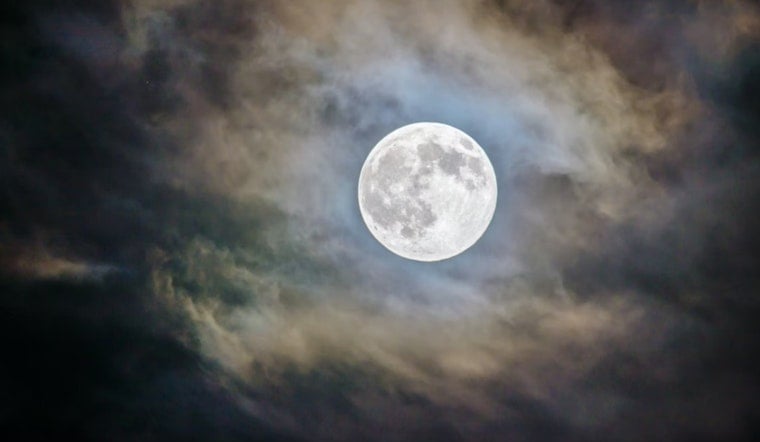
Arizonans and stargazers nationwide are in for a treat this weekend as the first supermoon of 2026, dubbed the Wolf Moon, prepares to make its nocturnal debut. According to the Phoenix New Times, this lunar event is set to rise tomorrow evening and will be most noticeable just after sunset when it's positioned close to the horizon. The moon is anticipated to appear slightly larger thanks to its proximity to Earth at perigee—the point in its orbit where it's closest to our planet.
For those aiming to catch the best view, the full moon will rise at 4:04 p.m. in Arizona, and skywatchers should look towards the east to northeast. Infusing the skies with a celestial spotlight, the supermoon is expected to reach its brightest point, about 98% luminosity, making it a stunning sight against the night's canvas. Despite potential cloud cover that could briefly obscure views, the supermoon’s grandeur is expected to shine through. Peak illumination is predicted for 11:26 p.m. when the moon reaches its zenith in the southern sky.
The cosmic event also carries the weight of tradition, as the term "wolf moon" originates from Native American and European practices during this time of year when wolves were often heard howling, as described by the Yahoo News article. Although the name suggests a hunger-induced howl, modern research suggests wolves use their voices more for territorial and pack communication. Nevertheless, the evocative name of the Wolf Moon endures and resonates across cultures.
With no need for telescopic aids, the lunar spectacle is just the first of three supermoons slated for 2026. The Beaver Moon will follow on Nov. 24, and the Cold Moon will make a close approach on Dec. 23, promising another round of the year's brightest moon on Christmas Eve. Yahoo News notes that on the evening of the Wolf Moon, it will sit alongside Jupiter, adding an extra kick to the skygazing experience. Place yourself with a clear view of the eastern horizon at moonrise or westward for moonset to witness the moon illusion, where our satellite seems most impressive when juxtaposed with familiar landscapes.





