

























































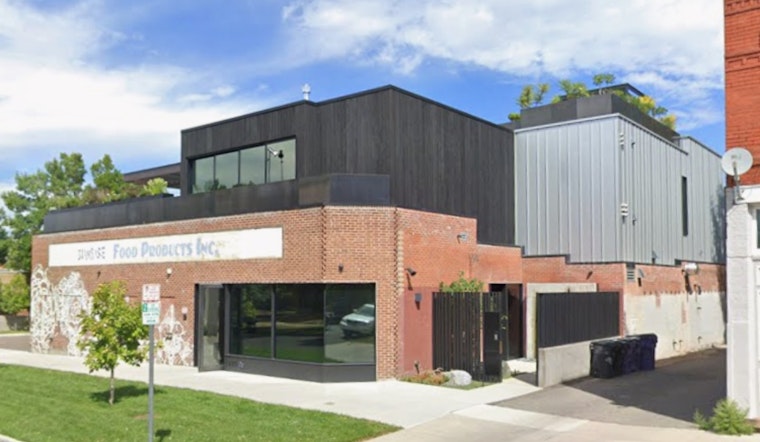
A long-abandoned fortune-cookie factory in Denver's Baker neighborhood has traded in paper slips for wall-sized installations. The onetime industrial husk is now the Cookie Factory, a privately funded art space at street level with a meticulously designed residence upstairs. Nearly a decade in the making, the project finally opened to the public in 2025, dropping ambitious, site-specific contemporary work right into the middle of a residential block. For neighbors, it is a rare chance to see big, museum-caliber projects in a small, free, walk-in setting.
Where to visit
You will find the Cookie Factory at 425 W. 4th Avenue in Baker. It is open to the public at no cost on Wednesdays from 4 p.m. to 7 p.m., with group visits and tours available by appointment, according to Cookie Factory. The site lists both an email and a phone number for scheduling and press requests. If you are hoping to stop by outside regular hours, the team asks that you get in touch first to confirm access.
A rescued industrial shell
The building started life in the 1940s as a paper mill before it became a fortune-cookie factory, and by the time collector and philanthropist Amanda Precourt bought it in 2017, it was badly deteriorated. She launched an extensive restoration that kept the original brick perimeter and wood-beamed ceilings while reworking the interior into about 5,700 square feet of ground-floor gallery space with a private residence on top, as reported by The Colorado Sun. The space debuted with a neighborhood block party in late May 2025 and has focused on commissioned projects and community activations rather than traditional gallery sales.
Big names, bigger statements
Upstairs, Precourt’s apartment doubles as a serious private collection. Cultured Magazine reports that the couple has assembled more than 140 works, including pieces by Lauren Halsey, Sterling Ruby, and Barbara Kruger. Among them is an Anselm Kiefer work that is said to be roughly 21 feet long and close to 2,700 pounds, heavy enough that the building had to be engineered to support it. Precourt describes the overall project as rooted in themes of recovery and community, and the artworks upstairs help shape the way the public-facing program unfolds below.
An artist-first program
The Cookie Factory’s programming leans on new commissions and collaborations, with Jérôme Sans listed as artistic director and Andrew Jensdotter as director of exhibitions, according to Jérôme Sans. Its inaugural show, Sam Falls’ Nothing Without Nature, ran from May 24 through Sept. 24, 2025, per Cookie Factory. Opening weekend reportedly drew about 2,500 visitors, as detailed by The Colorado Sun. The plan is to mount two solo projects each year, supplemented by periodic activations that blend visual art, performance, and community-focused programming.
Why it matters to Denver
Precourt presents the Cookie Factory as a civic offering, a privately funded alternative to a standard museum that exists to commission work and host public events rather than to move inventory. Her philanthropy is visible well beyond this one building. The Precourt Healing Center, a new inpatient behavioral-health facility in Edwards, was dedicated in May 2025, according to the Vail Health Foundation. In Denver, she has backed the Denver Art Museum’s recent campus overhaul, including galleries that now bear her name, as noted by PR Newswire.
What you’ll see
The venue steers clear of a white-cube salesroom vibe and instead leans into immersive, site-specific projects. Sam Falls’ “drop paintings” incorporated local plants as materials, and Gary Simmons’ recent project Rush combines large wall drawings with a community Reading Room that explores erasure and memory. The Simmons exhibition is scheduled to run through May 9, 2026, according to Essence. Local previews have also noted hands-on activities and outdoor banners that fold the factory’s brick exterior into the work itself, as covered by Westword. Because programs rotate, would-be visitors are encouraged to check local listings and the space’s own schedule for talks, performances, and new installations.
If you are in the neighborhood, you can drop in on a Wednesday evening or email ahead to set up a visit at another time. The Cookie Factory is designed as an accessible, non-commercial stop on Denver’s art circuit. For those who cannot get there in person, local arts outlets and the venue’s program page offer images and recaps of past shows that give a sense of the scale and ambition tucked inside that old factory shell.



