

























































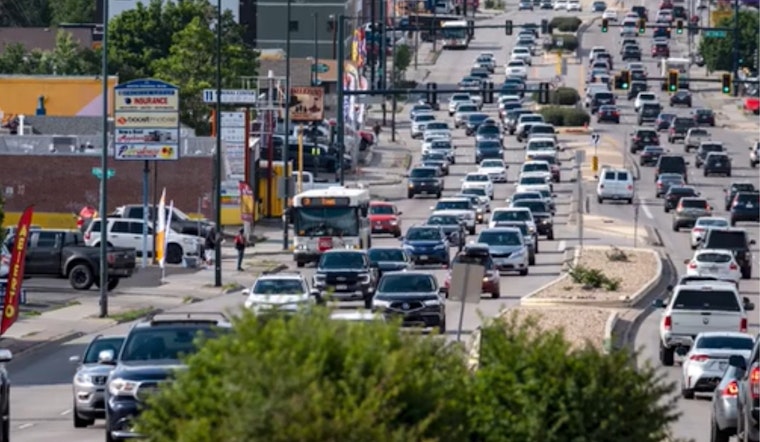
Federal Boulevard, one of Denver's busiest north-south arteries, is headed for a sweeping rebuild that could change how thousands of people move every day. The Colorado Department of Transportation is pressing ahead with a roughly $318 million overhaul that would layer bus rapid transit onto the corridor, lower posted speeds, and add safety features along an 18-mile stretch.
The current concept keeps two general-purpose vehicle lanes in each direction while adding raised boarding platforms, medians, landscaping, and, in many places, wider sidewalks. State officials say the goal is to move buses more reliably, cut down on crashes, and give people walking and biking a better shot at crossing the street in one piece.
Preliminary designs cover the length from Dartmouth Avenue on the south end to 120th Avenue in the north and call for curbside bus lanes, protected left-turns, sharper interchange geometry, and upgraded pedestrian crossings, according to CDOT. The agency describes the effort as a corridor-scale redesign that preserves two lanes each way for cars while carving out space for transit and people on foot. Environmental review and early design are expected to wrap in early 2026, with final design and phased construction after that.
Safety numbers on Federal are a big part of why the state is willing to spend this kind of money. The Denver Post reported that CDOT records show roughly 5,102 crashes on the corridor since January 2021, with at least 33 people killed in traffic during that time. CDOT deputy director Angie Drumm told the paper that the plan includes "signal headers over each lane to give greater visibility" along with other design choices intended to slow drivers and cut down on risky turns.
How The BRT Would Move People Faster
Transit planners are sketching out about 74 near-level boarding stations, spaced roughly a half-mile apart, with off-board fare payment and transit signal priority to shave time off each trip, according to Construction Review. Where there is enough room, the project would add curbside bus-only lanes. In tighter stretches in north and south Denver, buses would still share lanes with general traffic to avoid diverting drivers into nearby residential streets.
The bus rapid transit features are designed to make travel times more predictable for the heavy stream of daily riders who already depend on Federal. Near-level boarding and off-board payment are meant to cut the time buses spend stopped at stations, while signal priority is intended to keep them from getting stuck at red lights as often.
Funding And Timeline
Project leaders expect to cobble together funding from CDOT, regional and local partners, and a federal Small Starts grant that could cover up to about $150 million, according to the Federal Transit Administration. Advocacy groups and some officials have warned that any federal pause or a smaller-than-hoped-for award could mean the project has to be built in more, smaller chunks or trimmed back, a concern detailed by The Colorado Sun.
Design and environmental work are underway. Whether the finished product shows up in one big construction push or in several phases will depend heavily on how the funding package and right-of-way negotiations come together.
Community Reaction And Concerns
Not everyone along Federal is thrilled about what years of construction might look like at street level. At recent public meetings, business owners and residents said they worry long-running work zones could scare off customers.
The Denver Post quoted Celestial Bakery owner My Dodge saying construction "will hurt business and may force some to close," and reported that some transit advocates are pushing for bus-only lanes throughout the corridor instead of the shared sections now in the design. Residents, including Allen Cowgil, l have called for dropping posted speeds from 35 mph to 30 mph to improve safety for people walking, biking, and waiting at bus stops.
Next steps include finishing the federal NEPA review and moving into final design. CDOT staff have said work could start in phases as early as late 2027, with BRT service targeted around 2030, according to CDOT. Construction Review reported the roughly $318 million cost estimate and noted CDOT's recommendation to use a CM/GC delivery method in an effort to keep the schedule on track. In the meantime, state and city officials are keeping the public meetings and outreach going as designs are refined and the long-term funding picture comes into focus.





