

























































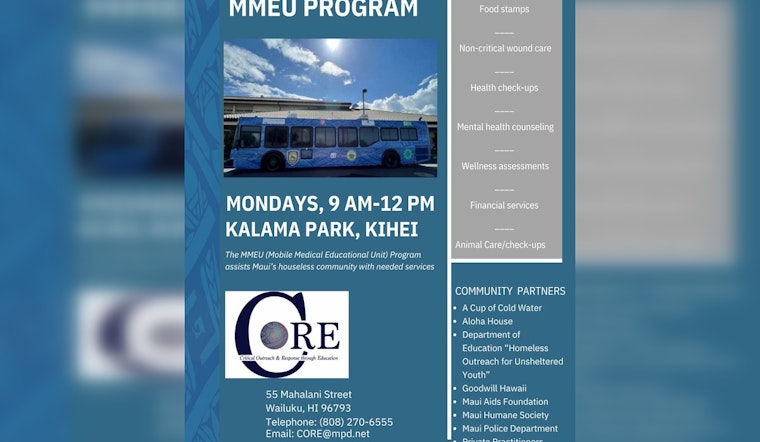
The Maui Police Department’s Mobile Medical Educational Unit is back on a weekly rotation at Kalama Park in Kīhei, turning a converted bus into a one-stop hub for people experiencing homelessness. The unit brings basic medical care, mental-health support and social services directly to the park, with outreach officers and volunteer clinicians focused on building trust and linking people to longer-term health and housing resources.
What the MMEU Offers
The mobile unit serves as a basic clinic and service desk on wheels. It offers health checkups, mental-health counseling, non-critical wound care and wellness assessments, along with help filling out food-stamp applications and accessing financial services. When veterinary partners are present, staff also line up animal checkups for people’s pets. According to the Maui Police Department, the MMEU is scheduled to be in Kīhei on Mondays from about 9 a.m. to noon. Organizers say that by combining medical triage, benefits enrollment and on-the-spot referrals in one location, the program lowers the hurdles for people who struggle to keep traditional clinic appointments.
Partners on the Ground
The effort leans heavily on local partners. The Maui Humane Society operates a mobile veterinary clinic at the park, providing waived-fee services and microchipping for pet owners experiencing homelessness. Groups such as the Maui Aids Foundation distribute hygiene kits, offer testing and share information about available benefits. Community organizations and private practitioners staff tables where people can get referrals and help applying for SNAP and medical QUEST. Local coverage has followed the unit’s recurring visits and the nonprofit coalition that joins it at Kalama Park, including coverage of the Kalama Park rollout.
How the Program Started
The MMEU started when the department outfitted a donated bus as a mobile clinic and held a blessing for the unit in Kīhei in 2021, as described in local reporting. The effort grew out of CORE, short for Critical Outreach and Response through Education, which pairs officers with social-work partners and volunteer clinicians to deliver care at street level. That model, highlighted by Hawaii News Now, is meant to meet people where they already are, rather than expecting them to travel to brick-and-mortar clinics and keep formal appointment schedules.
Why It Matters
Homelessness remains a major concern on Maui, which is one reason mobile outreach has become part of the county’s tool kit. Lawmakers and advocates have pointed to state data and local counts, including figures cited in House Bill 431 materials, that show several hundred people experiencing homelessness on the island in recent point-in-time surveys. Programs like the MMEU are designed to reduce immediate health risks, help people enroll in benefits and open up paths toward housing or treatment when those options are available.
How to Find the Unit
The department’s social post lists the current MMEU schedule and includes a direct line to the CORE team: email [email protected] or call (808) 270-6555, according to the Maui Police Department. For broader information, the department’s website carries main contact numbers and community pages with additional updates. Volunteers say residents who want to track the unit’s visits should keep an eye on the department’s social channels for any schedule changes.
Organizers describe the MMEU as a practical, low-barrier stop that fits alongside shelters, clinics and housing programs, offering a steady bridge between street outreach and more stable support in Kīhei.





