

























































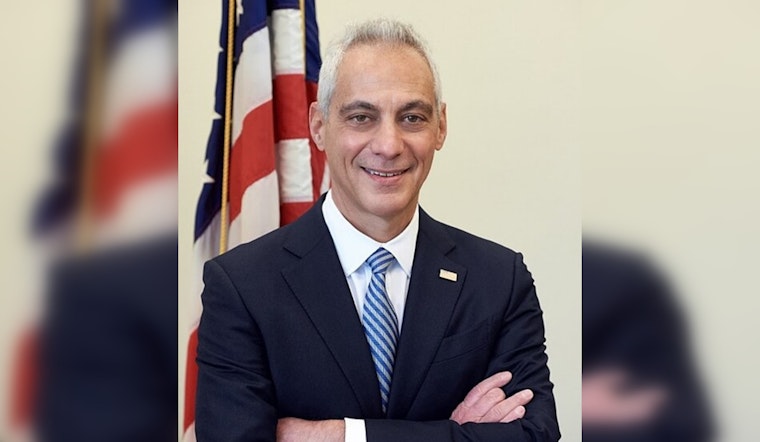
Former Chicago Mayor Rahm Emanuel is being pulled back into the center of the city’s long-running police accountability fight, after a federal judge ordered him to testify next week in a civil-rights trial over a botched 2018 raid that a Back of the Yards family says left four children traumatized. His appearance, expected a few days into a trial that could stretch to about three weeks, is a rare instance of a former mayor answering questions under oath about Chicago policing in open federal court.
The trial is set to kick off Monday, with Emanuel scheduled to take the stand on Feb. 3 after city lawyers tried and failed to block efforts to call him, according to WTTW News. Emanuel, who led the city from 2011 to 2019 before moving into national roles, declined to elaborate to reporters about the judge’s order.
The lawsuit, brought by the Tate–Eason family, centers on an Aug. 9, 2018 raid that plaintiffs say turned their home into a war zone. According to the complaint, officers used flash-bang devices, forced their way in with a pry bar and aimed assault rifles at children inside the apartment. One allegation in particular has drawn public outrage: “The Chicago police forced a 55-year-old grandmother to stand for an hour and fifteen minutes on the public street outside her home — in nothing but a braless T-shirt and underwear,” the filing states, as quoted by WTTW News. Officers did not recover any drugs or weapons, and the Civilian Office of Police Accountability ultimately closed its investigation without finding specific policy violations.
DOJ findings and the consent decree
This case is unfolding against a backdrop that federal investigators have already described in stark terms. In 2017, the U.S. Department of Justice concluded that a “code of silence” inside the Chicago Police Department allowed officers to act with impunity and helped shield misconduct from meaningful discipline. That report helped push the city into a federal consent decree that requires wide-ranging reforms in training, supervision and internal discipline systems, according to the Department of Justice.
The DOJ’s findings on systemic accountability failures are now part of the legal backdrop for the Tate–Eason lawsuit. Plaintiffs’ lawyers argue that the raid on the family’s home was not an isolated fiasco but a predictable outcome in a department where top officials had long been warned about warrant practices and culture problems yet failed to fix them.
An arc of problematic raids and settlements
Oversight reports and public data suggest the Tate–Eason raid fits a wider pattern of questionable search warrants that have haunted the city in recent years. The city’s Office of Inspector General found that the number of residential search warrants dropped sharply after 2019 and identified holes in how CPD develops, approves and tracks those warrants, according to watchdog findings highlighted by CBS Chicago.
Costly court settlements tell a similar story. The city has paid out millions in cases tied to botched raids and other alleged misconduct, and those payouts have helped fuel reform pressure. Public records compiled in the Police Funding Database include recent deals such as a $2.9 million settlement with Anjanette Young and a $2.5 million settlement with the Mendez family, illustrating how quickly the bills add up when things go wrong.
Legal implications
Plaintiffs in the Tate–Eason case argue that putting Emanuel under oath could help show that city leaders knew about the dangers in CPD’s warrant practices and still failed to get them under control. Civil-rights attorneys have long sought testimony from top officials to “memorialize” what they knew and when, and judges in earlier Chicago cases have at times insisted that mayors address questions about CPD’s culture and conduct. That legal push around Emanuel’s role and the broader “code of silence” debate was documented in earlier coverage by The Guardian.
If Emanuel takes the stand as ordered, jurors will hear from a former mayor whose tenure spanned the fallout from the Laquan McDonald killing and the DOJ probe, offering a rare window into how City Hall understood CPD’s problems and what it chose to do about them. The trial, beginning Monday, will be closely watched not just for what it reveals about search warrant practices, but also for whether Emanuel’s testimony shifts the legal and political stakes around police reform in Chicago.



