

























































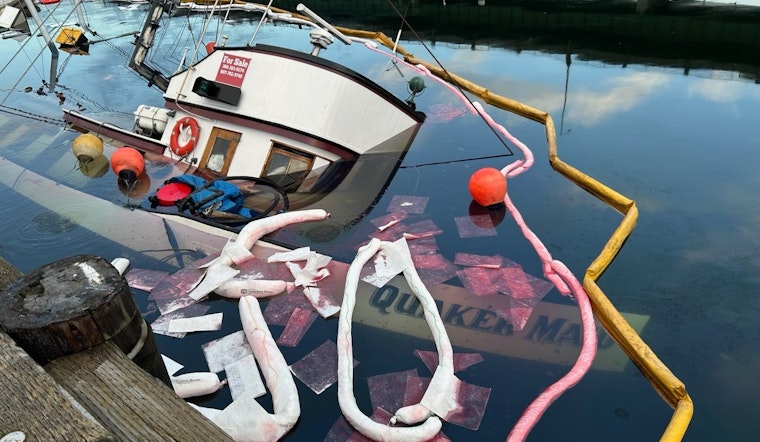
A week after the fishing vessel Quaker Maid went under at its moorage, responders say they have recovered more than 3,500 gallons of an oily water mixture from around the sunken boat at Fishermen’s Terminal. The 72-foot wooden-hulled vessel sank on Jan. 22 and set off a multi-agency cleanup in Salmon Bay. Crews quickly deployed boom and sorbent materials around the hull and worked to cut off any additional fuel from escaping while plans for salvage and removal are worked out.
According to KOMO, the Washington Department of Ecology and the U.S. Coast Guard reported the volume of oily water recovered and said the containment boom and sorbent material captured most of the release. A salvage contractor was brought in to plug vents where fuel was escaping, and officials told the outlet those vents have now been successfully sealed. Ecology officials said a light sheen remains on the water but is considered non-recoverable, and crews are continuing to monitor the cleanup and recovery work.
Containment and recovery efforts
Response teams typically lean on boom, sorbents, skimmers and pump-out operations to limit the spread of contamination and recover fuel near shore, according to the Washington Department of Ecology. The Washington Department of Ecology describes these tools as standard first-line actions, from deploying floating booms to laying absorbent pads and running skimming equipment to pull up any recoverable product. When conditions allow, divers and salvage technicians go directly to the source, plugging vents and accessing tanks aboard a sunken vessel to stop leaks at the hull.
What sank and what’s next
Officials describe the Quaker Maid as a 72-foot wooden-hulled commercial fishing vessel that went down at its slip at the Port of Seattle’s Fishermen’s Terminal. KOMO reports that crews have removed more than 3,500 gallons of oily water from around the hull and that the U.S. Coast Guard will work with the Washington Department of Natural Resources to determine a formal salvage or removal plan. For now, the harbor stays under close watch as responders lock in the next steps for raising or removing the wreck.
Why it matters locally
So far, officials report no shoreline impacts or oiled wildlife, and operations at Fishermen’s Terminal have not been broadly disrupted. Still, a sunken vessel at its moorage can turn into a long-running headache, with ongoing cleanup costs and navigation concerns. Recent incidents in the region have seen unified commands between the Coast Guard and Ecology tackle similar cases, sometimes pulling thousands of gallons of oily water from the scene. WorkBoat covered a comparable tug sinking in Bremerton that required an extended recovery effort.
Ecology and Coast Guard pollution responders plan to remain on scene to keep an eye on conditions while a salvage plan is finalized and recovery continues. Boaters and the public are being asked to steer clear of boom lines and the immediate work zone until authorities say the area is safe.



