

























































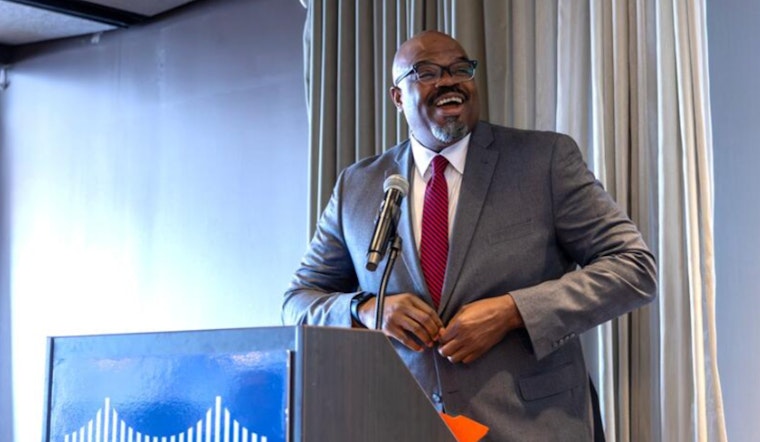
Secretary of Education Dr. Patrick Tutwiler highlighted the Healey-Driscoll Administration’s ongoing commitment to transform Massachusetts’ educational landscape during an address at the Rennie Center’s annual summit. Outlining a broad spectrum of advances, Tutwiler referred to the administration's "stabilize, heal, and transform" agenda and shared updates on early education, literacy initiatives, local education funding, reimagining high school, and higher education, as reported by the Massachusetts government.
"Three years ago, the Healey-Driscoll Administration hit the ground running with three organizing principles as the underpinning of our work—stabilize, heal, and transform," Secretary Tutwiler stated, as per a report from the Massachusetts government. He lauded the gains in education sectors, fueled by historic investments from the administration and legislative partners. He discussed the 'Gateway to Pre-k' agenda, noting a substantial increase in early education and child care availability, as well as detailing the funding of the Child Care Financial Assistance programs at $1.2 billion.
The Secretary pointed to the administration's continued dedication to early literacy, backing the augment with a proposed $50 million investment. The initiative has already delivered over $10 million in Literacy Launch grants to 45 school districts for grade-level reading improvements. In conjunction with the Literacy Launch, an early literacy high dosage tutoring initiative was also cited as enhancing reading and writing skills among first graders.
Acknowledging the fiscal pressures on school districts, the administration proposes to fully fund Chapter 70 local education aid. This includes the Special Education Circuit Breaker, and transportation reimbursement, with tailored assistance for rural districts, according to the state's official website. An additional $198 million is proposed to maintain universal free school meals, with a minimum aid rate of $75 per pupil, and a specific $20 million earmarked for rural school aid.
Dr. Tutwiler also put an emphasis on reimagining high school education, aiming to ensure that graduates are prepared for the evolving demands of college, career, or civic life. The 'Reimagining High School' initiative seeks to expand Early College and Innovation Career Pathways programs, which provide hands-on industry experience. The K-12 Statewide Graduation Council's recommendations outlined a Vision of a Graduate, designed to be more reflective of the skills, knowledge, and experiences fitting for a graduate in today's society.
The administration's impact on higher education was not neglected, with Secretary Tutwiler underscoring significant expansions in state financial aid leading to increased college and university enrollment. The budget also features a proposed $38 million for student SUCCESS programming, designed to increase graduation rates and address food security on college campuses. The administration's comprehensive approach, highlighted by the Go Higher campaign to promote available financial aid, is a testament to their efforts to ensure that public college and university graduates are well equipped to achieve higher earnings post-graduation.





