

























































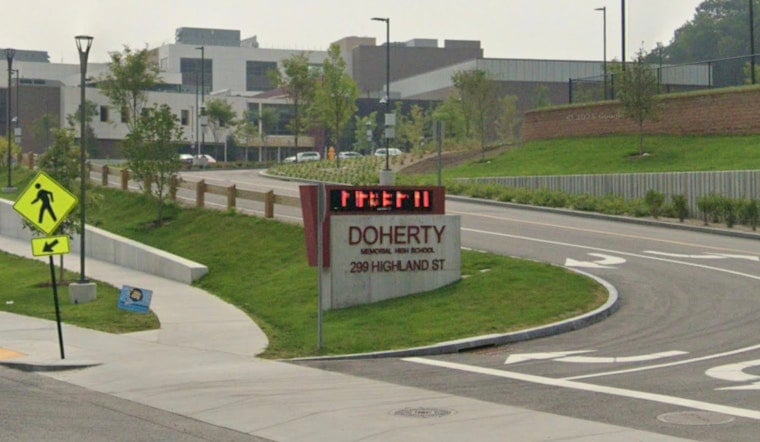
Worcester Public Schools has unveiled its first major boundary realignment in years, a sweeping proposal that would convert two long-standing magnet elementary schools into neighborhood-only campuses, shift middle schoolers onto single high school feeder paths, and overhaul the bell schedule into a three-tier system. District officials presented the initial scenarios Tuesday at Doherty Memorial High School, kicking off a three-month public comment period before any changes take effect.
The proposals stem from a district-wide capacity problem that has nothing to do with a shortage of seats and everything to do with where those seats sit. As reported by MassLive, the district shared its initial boundary scenarios publicly on August 14, with consultants Dillinger Research and Applied Data presenting the first draft of realigned attendance boundaries. Worcester Public Schools operates 45 elementary, middle and high schools serving 24,677 students during the 2025–2026 academic year, according to the Worcester Regional Research Bureau. Districtwide, elementary buildings run at an 84% average utilization rate, but individual schools swing from just 57% full to a packed 113%, per Worcester Sucks and I Love It.
That lopsided distribution is what's driving the plan to convert Jacob Hiatt Elementary and Worcester Arts Magnet Elementary School from citywide-admission magnets into solely neighborhood-based schools. Jacob Hiatt's magnet designation has carried programming that was phased out years ago, the district notes, and redesignating it as a neighborhood school would help alleviate overcrowding at Chandler Elementary. The Worcester Arts Magnet conversion, meanwhile, is meant to absorb enrollment growth expected from new housing developments in the Burncoat quadrant — a pressure line that connects directly to the city's recent approval of 74 apartments at the former Hovey Laundry site, as Hoodline reported.
Boundary Shifts Ripple Across Multiple Quadrants
The initial scenarios also touch several other overcrowded campuses. The Gerald Creamer Center, currently an alternative high school, would relocate to the Fanning Building on Chatham Street and be converted into a neighborhood-admission PreK-6 elementary school, a move designed to address overcrowding at Rice Square and Grafton Street elementary schools. Both Rice Square and Grafton Street would send their sixth-grade students to Worcester East Middle School, joining Rice Square students who already attend that school, per the district's proposal outlined by the same account.
Elsewhere, the Plumley Village housing development — currently split between City View and Belmont Street schools for enrollment purposes — would be rezoned entirely to City View Elementary. Belmont Street Elementary itself would shift from the North quadrant into the Burncoat quadrant under the plan. Francis J. McGrath Elementary School, which sits adjacent to Forest Grove Middle School, could gain elementary arts magnet programming relocated from Worcester Arts Magnet, along with enhanced performance-area availability for students.
Under the broader feeder alignment, middle school students would be zoned to a single high school, and elementary students would be mapped to a single middle school, establishing clearer K-12 pathways than the district's current patchwork. Jermaine Johnson, who worked with Dillinger Research and Applied Data on the project, described the initial proposal as “scenario one” and stressed that it remains fluid. Johnson said the district needs the boundary project, according to the district's presentation materials.
A New Three-Tier Bell Schedule
Alongside the boundary changes, Worcester Public Schools would transition to a three-tier school-day system. High schools, Burncoat Middle School and specialized programs would run from 7:15 a.m. to 1:38 p.m. Remaining middle schools and elementary schools with special education hub programs would operate from 8:15 a.m. to 2:38 p.m. The remaining elementary schools would follow a 9:05 a.m. to 3:28 p.m. schedule.
District officials say the three-tier system would also expand school bus transportation access. That claim carries weight given the district's track record: Worcester Public Schools brought all student busing in-house during the 2022–2023 school year, a move that reduced parent service complaints by 76% and saved the district $5 million annually, according to Worcester Public Schools. The district will also review voluntary and tiered start times as part of the broader scheduling review.
Preschool Expansion and Other Reviews Underway
The district is recommending at least one full-day preschool classroom in every elementary school, with full-day preschool expansion occurring over a multi-year timeline as federal and local funding permits. Separately, Worcester Public Schools will review the lottery system used for students seeking vocational-technical programs, a review that comes as state regulations now require oversubscribed Chapter 74 Career Vocational Technical Education programs to shift to a blind lottery admissions system beginning with the 2025–2026 application cycle for Fall 2026 entry, per the Massachusetts Department of Elementary and Secondary Education.
The district also plans to update several school names to remove obsolete terms including “community” and “magnet,” reflecting the shift toward neighborhood-based admissions. None of this comes with a total price tag attached in the materials released so far, and Worcester Public Schools has made no final decisions on any of the proposals — officials have repeatedly emphasized that the current scenarios are a starting point for community input, not a finished plan.
Legal Backdrop and Investment Context
The boundary review unfolds against a legal backdrop that adds weight to how the district frames these changes. In May, nine Black and Latino students filed a lawsuit in Suffolk Superior Court alleging that state education officials maintain unconstitutionally segregated public schools in Gateway Cities including Worcester through neighborhood assignment boundaries, as Hoodline detailed in its earlier coverage of the statewide desegregation lawsuit. Worcester's student population is 45.8% Hispanic or Latino, 23.9% White, 19.8% Black or African American, 6.2% Asian and 4.0% multi-race, according to Massachusetts Department of Elementary and Secondary Education data for the 2025–2026 school year, underscoring the equity stakes tied to any boundary redraw.
The realignment also follows major recent capital investment in district facilities. Worcester dedicated a new $314 million, 420,000-square-foot building for Doherty Memorial High School in October 2024, built to house up to 1,670 students, according to the Worcester Guardian. The Massachusetts School Building Authority separately approved a feasibility study in May 2025 for a new Burncoat High School building, launching a five-to-seven-year process that will evaluate combining middle and high school facilities on a single campus. Early College enrollment within the district has also grown substantially, from 714 students in 2023 to 1,362 in 2026, per data from Mass.gov, a trend district leaders say the streamlined middle-to-high feeder pathways are meant to support.
How to Weigh In
Worcester Public Schools will host eight public forums and meetings between September 2 and November 7 to gather community comments on the initial scenarios. Community members can also submit feedback by email, and parents and guardians can receive project updates through the district's ParentSquare group. A community input mapping tool on the district's school boundary and quadrant alignment project website allows residents to view potential address-specific boundary changes, alongside presentation materials, explanatory videos, timelines and meeting locations.
Consultants are expected to present final recommendations to district leaders and the School Committee in December, with Worcester Public Schools submitting its final recommendations to the committee that same month. Until then, officials say every scenario now circulating remains subject to change based on what residents tell them over the next three months.





