

























































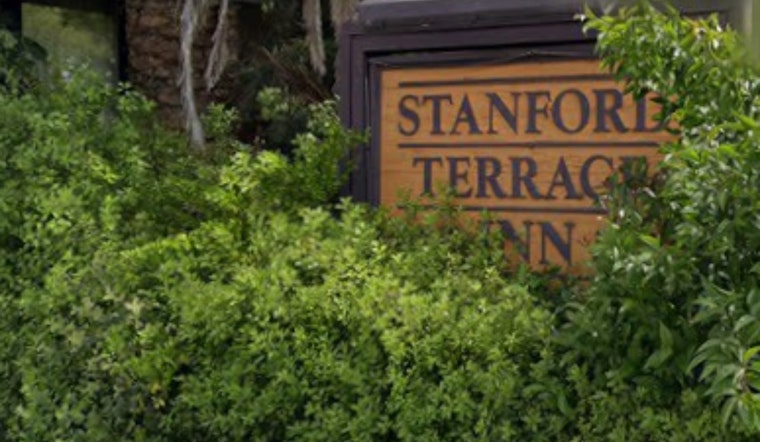
Developers are not backing off their bid to replace the long‑shuttered Stanford Terrace Inn with 22 detached homes, and they now want Palo Alto to put the project on a fast track under new state housing rules. The property at the edge of College Terrace has been fenced off since the hotel was red‑tagged, and the applicants say a revamped modular design will deliver houses faster than a standard build. Their attorneys recently asked city planners to approve demolition and construction on separate tracks so work can be staged, a request that is already setting up a procedural fight with city reviewers. Neighbors and council members are gearing up for a familiar Palo Alto showdown over design, density and the loss of a small, often controversial lodging site.
In a Jan. 16 letter to Planning and Development Director Jonathan Lait, attorneys for the owners said they were filing under Assembly Bill 130 to seek a CEQA exemption and urged the city to clear the way for subdivision and building permits, according to Palo Alto Online. The letter lays out the revised concept: 22 detached, three‑story homes, each with three bedrooms, three‑and‑a‑half bathrooms and two parking spaces, and asks that demolition be processed separately from the development approvals. The applicants told staff they have already lost time and money under the existing review process and want clear direction on sequencing and sign‑offs. The letter closes by saying the owners look forward to providing 22 new homes and working collaboratively with the city.
What the revised plan would look like
The new design trims back an earlier, larger builder’s‑remedy proposal in favor of a row of nearly identical three‑story modular houses with private garages and roughly 2,500 square feet of living space, according to project filings and renderings. SF YIMBY notes the plans rely on HCD‑approved modular units and include one deed‑restricted home for a very‑low‑income household. Local reports add that the modules are narrow, about 15 by 48 feet, and would be packed into a tight grid across the roughly three‑quarter‑acre parcel. The Palo Alto Daily Post reports the application was submitted in late August on behalf of owner Sophia Huang.
How AB 130 changes the calculus
The applicants are leaning heavily on AB 130, a 2025 state budget‑trailer law that created a new statutory CEQA exemption for certain infill housing, a shift that can sharply cut environmental review time. Legal analyses explain that qualifying projects can move forward without a full EIR and that cities face strict shot‑clock deadlines once an application is deemed complete. AB 130 spells out the eligibility rules and procedural timelines, while Holland & Knight notes that the exemption tends to shift battles away from the EIR stage and into local fights over entitlements and design.
Tower complicates demolition sequencing
The owners’ attorneys also flagged a practical headache: an on‑site T‑Mobile wireless installation that they say makes it hard to demolish first and build later because the carrier wants uninterrupted service. Their proposal offers a temporary modular structure to house the equipment during construction. Palo Alto Online reports that the team has outlined a plan to set up a module where the tower can be relocated so customers do not lose coverage. In their correspondence, the lawyers point to three procedural snags they say are slowing the project: the city’s handling of separate demolition and development approvals, uncertainty over an AB 130 exemption and density‑related sign‑offs. Those questions must be settled before Palo Alto can sign off on a lot subdivision or issue building permits.
City response and permitting hurdles
City staff say earlier project filings were incomplete and that the proposal is still under review, and local coverage shows inspectors began taking a harder look at the site after safety worries surfaced in 2023. The Palo Alto Daily Post reported that officials originally red‑tagged the hotel after firefighters found problems with sprinklers and alarms. The city’s project page currently lists an environmental assessment as pending and labels the application as Preliminary SB 330, a sign that staff are still working through entitlement steps before any demolition can begin. The City of Palo Alto identifies planner Garrett Sauls as the staffer assigned to the case.
Neighbors and legal history
The property was formally red‑tagged in 2024 after inspectors documented a broken fire‑sprinkler system, expired permits and other code violations, and that episode left behind a messy legal trail that still shapes today’s debate. SF YIMBY and other local reports note that tenants, many with Stanford ties, were relocated and that several former residents later sued the owner. A judge ultimately tossed key portions of that lawsuit and the parties reached confidential settlements, but neighborhood groups are still pushing for strict design conditions and careful construction sequencing if housing is approved. That history is almost certain to resurface as staff and the public debate whether to let the project proceed under AB 130’s faster track.
Legal implications
Relying on AB 130 could speed things up, but it does not wipe out legal risk. Opponents can still challenge local permits, subdivision approvals or compliance with other state housing rules, and in many cases the fight simply shifts from CEQA lawsuits to arguments over municipal codes and subdivision law. AB 130 includes the criteria and deadlines Palo Alto must apply to decide whether this project qualifies for a CEQA exemption. If the city denies the exemption or rejects a key plot plan, the developers say they will need some assurance about the site’s economically beneficial use while a final subdivision map is processed. That kind of back‑and‑forth can generate its own appeals and lawsuits in county superior court.
What’s next
For now, the project is stuck at the staff review stage, with the city’s environmental assessment still listed as pending and no construction timeline in place. The City of Palo Alto lists the proposal as application 24PLN‑00107 and provides a staff contact for questions. Developers say they are ready to push for plot‑plan approval and a split demolition schedule in order to stay on a rapid track, while neighbors and council members are expected to keep pressing for design revisions and deeper affordability. The next round of sparring is likely to unfold at public hearings and staff briefings in the coming months, as both sides test how far the new state rules on fast housing approvals will really go in Palo Alto.





