

























































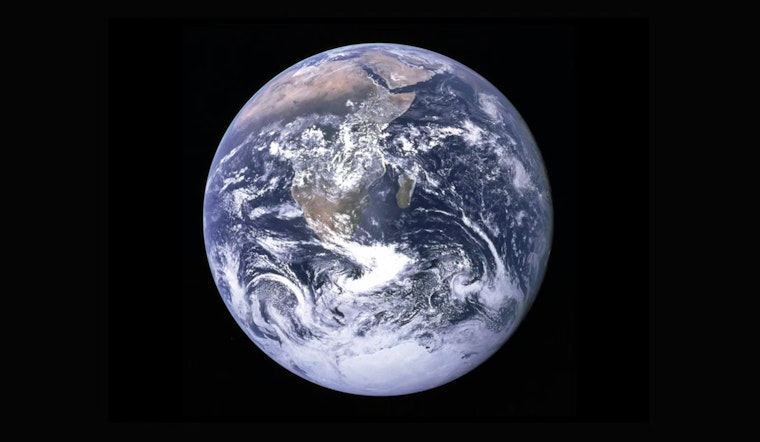
When observing the night sky, space is often imagined as a vast expanse extending in all directions, with Earth positioned within it. According to the University of Tennessee, a common question that follows is what exists “below” the Earth in this context. To address this, University of Tennessee professor Jeff Moersch explained the concept for the Curious Kids series published by The Conversation.
Illustrations of the solar system often depict the planets aligned and orbiting the sun along a single plane, creating a flattened appearance. This can raise questions about what exists beyond that narrow view. Professor Moersch, who works with robotic spacecraft, highlights the importance of understanding the solar system’s three-dimensional structure, which is essential for planning and carrying out missions involving rovers and orbiters.
Because space extends in all directions, what lies below Earth is simply more space, containing stars, galaxies, and other celestial objects. The universe does not have a defined up or down. The solar system appears relatively flat due to its formation, as the conservation of angular momentum and the accumulation of material around the protosun caused it to form a disk, creating the orbital plane observed today.
Moersch’s explanation helps clarify complex astronomical concepts by presenting them in an accessible way. He explains that while direction in space is relative, the structure of the solar system can be understood through basic principles of physics. For researchers and professionals involved in studying and mapping space, including teams at the University of Tennessee, this type of analysis supports mission planning and contributes to a broader understanding of Earth’s place within the universe.





