

























































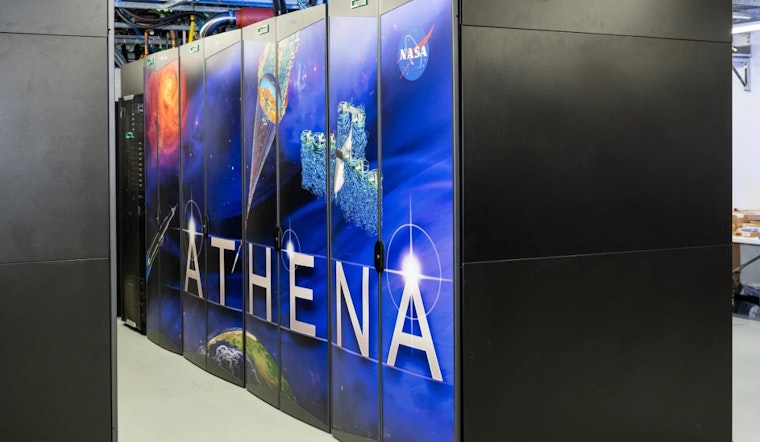
A quiet hardware swap at Moffett Field just changed the math for NASA. Athena, the agency's newest supercomputer, slipped into full production at the Modular Supercomputing Facility at Ames Research Center in January and is now the most powerful system in NASA's fleet. The CPU-based machine delivers more than 20 petaflops of peak performance and can shrink research runs that once took weeks on older hardware down to days, giving engineers room to run larger simulations and train bigger AI models without waiting forever for results.
What Athena Is And How Big It Is
Athena is a 1,024-node HPE Cray EX4000 system built on high-core-count AMD EPYC Turin processors, offering a theoretical peak of about 20.132 petaflops with roughly 262,144 cores and 786 terabytes of memory, according to NASA's High-End Computing Capability program. The machine sits inside the Modular Supercomputing Facility at Ames and uses a Cray Slingshot-11 interconnect to move data between nodes. That setup is tuned for CPU-heavy workloads such as fluid dynamics, launch-vehicle simulations, and large-scale AI model training.
How Researchers Will Use It
NASA says Athena will power spacecraft and aeronautics modeling, climate and planetary science, and the training of foundation-scale AI models for massive datasets, according to NASA. Donovan Mathias, division chief of NASA's Advanced Supercomputing Division, told the Mountain View Voice, "The big thrust of the analysis that we’re looking for Athena to do at this time is supporting human spaceflight to get our crew safely into space and back home." Mathias also told the Voice that Athena can do about 75% more work per year than Pleiades and is roughly four times more energy efficient, figures he framed as key to running more and larger studies without ballooning power costs.
Replacing Pleiades And The Rollout
Athena succeeds Pleiades, the decade-old system that debuted in 2008, and represents a major jump in on-premises CPU capacity; Pleiades offered roughly 7.09 petaflops versus Athena's 20.13, Datacenter Dynamics reports. According to NASA's HECC knowledge base, Athena was released to full production for all users on Jan. 14, 2026, after a beta period, marking a quick transition in the agency's high-end computing portfolio. The change is meant to relieve the backlog and give engineers a faster turnaround for mission-critical analysis.
Who Can Access It And Why It Matters Locally
The supercomputer is available to NASA researchers and to external scientists and engineers who can apply for allocations through NASA's Advanced Supercomputing program, according to NASA. For Mountain View and Moffett Field, Athena is another anchor for high-end research at Ames and a new resource for Bay Area teams that design, test, and analyze the hardware and software that will carry humans back to the moon and, eventually, to Mars.





