

























































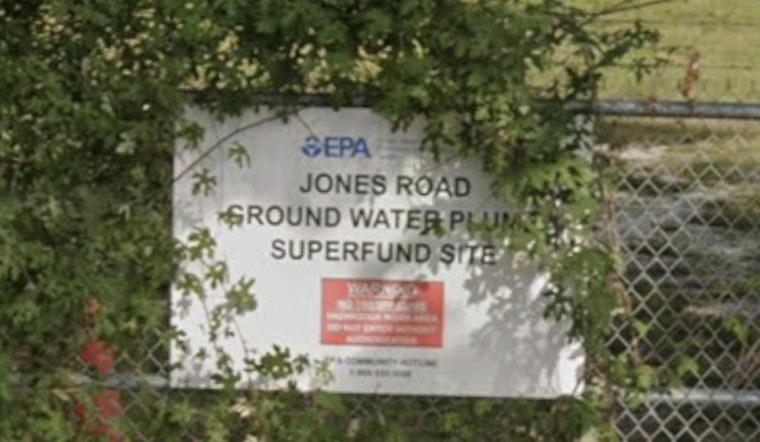
Federal crews are back in the Jones Road area this month for a second crack at a groundwater mess that never fully went away. Phase two of a federal investigation is underway after earlier cleanup efforts were deemed not enough to fully protect people who rely on nearby wells. At the center of it all is a decades-old plume of dry-cleaning solvents that federal records trace to the former Bell Dry Cleaners behind the Cypress Shopping Centre. Neighbors say low-level contamination is still turning up in private well tests, and many households now lean on bottled or municipal water for drinking and cooking.
EPA resumes subsurface testing
The U.S. Environmental Protection Agency's Superfund site page lists Phase II fieldwork in January 2026 and sets a remedial-investigation and feasibility-study target of September 2026. Those milestones will shape any new cleanup plan the agency proposes. The work includes more groundwater and vapor-intrusion sampling, updates to the conceptual site model and the possible installation of additional monitoring wells.
EPA officials say the fresh data will feed three-dimensional modeling to pinpoint where contamination still lingers and to help identify a long-term fix, according to the U.S. Environmental Protection Agency.
Cone probes, modeling and new funding
EPA Region 6 press officer Joe Robledo told Community Impact that contractors are using cone-penetration testing to sample groundwater at multiple depths. Those readings will guide where to place new monitoring wells and how to refine the three-dimensional model of the plume.
The new round of fieldwork follows a $3.2 million contract extension the agency approved in 2025 to finish a supplemental remedial investigation and feasibility study, as previously reported by Community Impact. Residents told the outlet they are still seeing trace amounts of the dry-cleaning chemical tetrachloroethylene in household testing and have steered clear of using tap water for drinking and cooking.
Health risks and community pressure
The Texas Health and Environmental Alliance has been pressing for quicker action and has told local partners it expects another round of groundwater testing in April, followed by community outreach. The dry-cleaning solvent tetrachloroethylene, also known as PCE, can harm the nervous system, liver and kidneys and has been linked with certain cancers, according to the Agency for Toxic Substances and Disease Registry.
Community groups and local officials say the expanded testing must be paired with more waterline connections to cut ongoing exposure risks for households still on private wells.
Water lines, costs and limits of the fix
EPA has offered to connect affected properties to the White Oak Bend municipal water system and will shoulder the initial hookup costs. Homeowners, however, are responsible for the continuing municipal utility district bills. Agency materials note that past cleanup actions included tying homes and businesses into public water and placing restrictions on new well drilling in the area.
Even with those options on the table, some residents say MUD taxing-boundary rules and higher water rates can make the switch to public water financially tough. That has kept several private wells in use, according to the U.S. Environmental Protection Agency.
Next steps and where to get information
EPA expects the ongoing study to shape a proposed remedy this year and says the new field data will determine whether the 2010 cleanup plan can be salvaged or has to be replaced. The agency needs permission to enter properties in order to collect samples, so access agreements are required for private wells and yards.
Residents who want to grant access or request a waterline hookup can contact EPA Remedial Project Manager Lauren Guidry-Leach at [email protected] or 214-665-2714, or Community Involvement Coordinator Jason McKinney at [email protected] or 214-665-8132. Local advocates say showing up at public meetings and signing those access forms will be key to mapping the plume accurately and moving a long-term fix from paper to reality.




