

























































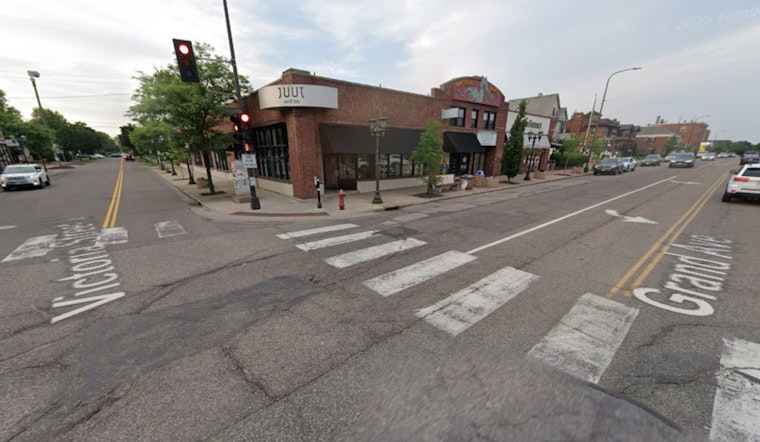
A new engineering review of the Victoria Crossing properties at Grand Avenue and Victoria Street in St. Paul has turned up a laundry list of building and code problems, with repair bills climbing into the hundreds of thousands of dollars and, in one combined estimate, nearing a third of what it would cost to rebuild. Those numbers are now bearing down on officials who must decide whether the block should be declared structurally substandard, a label that can open the door to demolition, redevelopment or public financing.
According to the Pioneer Press, the city hired engineering firm LHB to conduct a structural analysis of the buildings at Grand and Victoria. The resulting inspection report catalogs dozens of deficiencies and failing systems throughout the small central mall and the neighboring storefronts, outlining a to-do list that reads more like a gut rehab than a quick tuneup, the paper reports.
The LHB report, as quoted by the Pioneer Press, states that the foundation at 841 Grand Ave. "is deteriorating and should be reinforced, per code," and concludes that the overall repair tab would come to about 29% of the cost to replace the buildings. The report pegs more than $708,000 in repairs for the central mall, whose replacement cost is estimated at roughly $2.9 million; about $500,000 in repairs for the adjoining building that formerly housed Billy’s on Grand, with a replacement estimate of about $1.3 million; and more than $151,000 in repairs for the three-story house at 841 Grand, which LHB estimates would cost roughly $449,000 to replace.
Line-item fixes and what they add up to
The LHB review breaks out the damage into specific line items, and the totals add up fast. For the central mall alone, the report lists HVAC work at $157,000, code-compliant lighting upgrades at $156,000, roof repairs at $181,000, and new windows estimated at $74,000. The adjoining building’s biggest single items include an HVAC overhaul at about $266,000, window replacement at $40,000 and roof work at $61,000. At 841 Grand, the house would need window and siding repairs estimated at $72,000 and roof work near $13,000.
What “structurally substandard” really means
Under Minnesota law, a building is generally not considered structurally substandard if it can be brought up to current code for less than 15% of the cost of constructing a similar new building. Once repair costs cross that line, a city can deem the property structurally substandard for redevelopment purposes. That legal threshold appears in Minnesota statute §469.174, which also allows local authorities to lean on professional inspections and cost estimates when making the call.
Development pressure and city review
The Grand and Victoria block has already been on developers’ wish lists. A proposal surfaced to replace the Victoria Crossing East Mall with a new project combining apartments and street-level retail, and the site was rezoned last year to accommodate that vision, according to Finance & Commerce. That outlet reported early renderings and a plan for roughly 80–90 apartments stacked above new commercial space.
Legal implications and next steps
If St. Paul ultimately determines that the Victoria Crossing buildings are structurally substandard, that finding could be used to establish a redevelopment or renewal district and to authorize public incentives such as tax-increment financing to help pay for demolition and new construction. Courts have, in the past, pushed back on how cities calculate and defend such designations, so any move toward clearance or incentive deals is likely to involve a careful vetting of the LHB report, city staff analysis and any appeals that might follow. One earlier example of judicial scrutiny in this arena is Walser Auto Sales v. City of Richfield.
For now, the LHB findings layer hard numbers onto a debate that has mostly centered on housing and retail along Grand Avenue: whether to shore up the aging storefronts or clear the way for something entirely new. City officials, developers and neighbors will be weighing those repair estimates against neighborhood history and the political appetite for public subsidies at a corner many say is overdue for reinvestment.




