

























































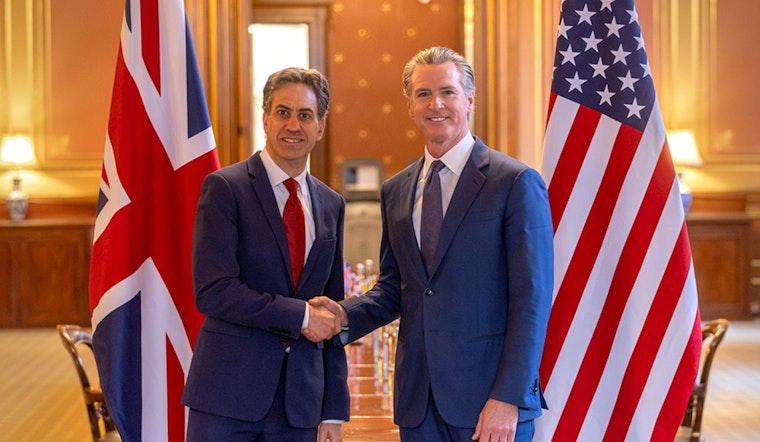
Gov. Gavin Newsom took his climate pitch overseas on Monday, signing a clean-energy memorandum of understanding in London with U.K. Energy Secretary Ed Miliband and walking away with a near-$1 billion investment pledge for California projects. The deal zeroes in on offshore wind as a headline item and is meant to fast-track research tie-ups, business partnerships and pilot projects shuttling across the Atlantic.
What the agreement covers
According to GOV.UK, the memorandum prioritizes work on clean energy technology, climate resilience, carbon management, transport decarbonisation and financing. The U.K. government says the pact will strengthen partnership to boost transatlantic investment and lays out a framework for policy dialogues, research exchanges and business matchmaking between the two governments. Newsom signed the document in London on Monday alongside Miliband.
Who’s putting money behind it
Octopus Energy Generation said in a press release that it plans to invest nearly $1 billion in Californian clean-tech and nature-based projects, including carbon removal, heat batteries and solar-plus-storage. The company framed the move as part of a strategy to bring British technology and finance into the U.S. market and to scale up promising pilot efforts. Officials on both sides pointed to the private money as a crucial companion to the state-to-state pact, not just window dressing.
How it fits into California’s plans
California has planning targets of roughly 2–5 gigawatts of offshore wind by 2030 and 25 GW by 2045 as part of its broader clean-energy goals, according to the Governor’s Office. State leaders point to earlier federal lease auctions and existing developer interest off the central and northern coast as evidence that the market is primed for new investment. Supporters argue that tighter links with U.K. firms could speed up technology transfer, sharpen competition and, in time, help drive down costs for Californians.
Federal headwinds add urgency
The timing is not accidental. The move comes as federal policy shifts have cooled large-scale offshore wind planning. The Bureau of Ocean Energy Management rescinded designated Wind Energy Areas on July 30, 2025, stripping more than 3.5 million acres that had been targeted for wind development. That step, along with other federal changes, has injected fresh uncertainty for developers and made predictable state-level partnerships more appealing to investors. Advocates say the new MoU could serve as a steadier market signal for companies willing to deploy technology in California despite the turbulence.
Political reaction
The deal did not land quietly at home. Former President Donald Trump blasted the pact as "inappropriate" and attacked Newsom’s record in remarks cited by The Guardian. Newsom’s office shot back that foreign leaders are choosing California’s vision for the future, turning a climate announcement into yet another proxy fight over the state’s direction. Local coverage of the signing and the investment, including reporting from CBS Sacramento, highlighted how the rollout paired government diplomacy with a splashy private-sector commitment.
What comes next
Both governments say the MoU creates a five-year framework for dialogue, joint research and business events that could lead to pilot projects and eventually commercial deals, according to GOV.UK. The real test will be whether follow-on agreements materialize, private capital actually hits the ground in California, and projects make it through the state’s permitting gauntlet. If those pieces line up, officials contend the pact could seed new jobs and technologies on both sides of the Atlantic, not just generate glossy photos of a signing ceremony in London.



