

























































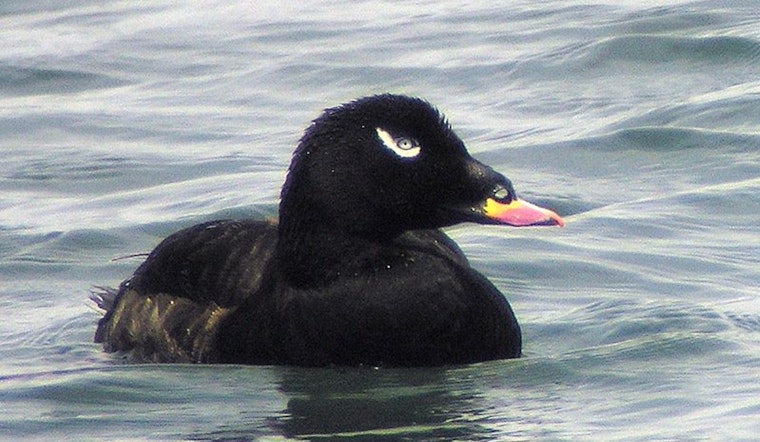
On an otherwise ordinary day at River Park along the North Branch of the Chicago River, a group of birders snapped what looked like a classic “catch of the day” shot: a white-winged scoter in the act of swallowing a bright red swamp crayfish. That single, well-timed photo did more than light up local birding feeds - it handed scientists a key piece of proof about how microplastics may be moving through the river’s food web.
Research in the river
For months, Loyola University researchers have been trapping and dissecting invasive red swamp crayfish in the North Branch and North Shore Channel to test for microplastics as part of an ongoing project. Preliminary results and project listings from the Keller Lab, along with an initial presentation to the Association for the Sciences of Limnology and Oceanography, document that invertebrate sampling and microplastic analyses are central to the team’s work, with both sources detailing the focus of the research.
Birders supplied the missing proof
Local photographer Mike McCawley was the one behind the lens at River Park, capturing a series of images that show a white-winged scoter gripping a red swamp crayfish in its bill. When the shots were shared on social media, they did more than delight bird watchers. They provided the direct documentation researchers had been looking for, confirming that birds in the North Branch are indeed eating the invasive crayfish. That confirmation, as reported by WTTW, plugged a crucial gap in the food-chain story.
Startling microplastic counts
Once the crayfish were in the lab, Loyola graduate student Tava Oosterbaan began dissecting them and tallying what was inside. What she found in their digestive tracts was, in her words, “startling” - in some cases, microplastic loads were 10 to 300 times higher than values reported in the scientific literature. Oosterbaan told reporters, “There are no numbers higher than ours - that I know of yet,” and said most of the material was polyester-, acrylic- and nylon-based microfibers that often clumped into so-called “fiber balls,” according to WTTW.
Mussels, ducks and the food‑chain puzzle
Oosterbaan also sampled invasive zebra and quagga mussels from the same channel and found that those mussels appeared to contain far fewer microplastics than the crayfish. The Keller Lab lists that mussel work as part of the student’s sampling effort. Broader literature on dreissenid mussels shows that microplastic uptake can vary widely by site and by animal size, so the relatively low mussel counts fit into a complicated picture of how different filter feeders interact with tiny particles. A review in Frontiers provides context for that variability.
Where the plastics - and the crayfish - might be coming from
Scientists point to several likely routes for both the particles and the animals: stormwater runoff and litter along the banks, treated effluent, and the pet and aquarium trade, which has long been documented as a way species such as Procambarus clarkii get moved around the globe. Ecological studies have described the aquarium and ornamental trade’s role in spreading nonnative aquatic species. Meanwhile, the Terrence J. O’Brien Water Reclamation Plant discharges to the North Shore Channel downstream of River Park, according to the Metropolitan Water Reclamation District, potentially creating locally favorable conditions for a southern species like the red swamp crayfish to persist.
What officials are saying
Agency representatives and water experts say conventional treatment systems already capture a large share of particles, but that stripping out the tiniest fibers is technically difficult and expensive. Allison Fore of the MWRD told Water Daily that while “most microplastics are removed during preliminary and primary treatment,” achieving full removal would require costly retrofits, and that the district is studying both the sources of microplastics and possible treatment options.
What began as a lucky wildlife shot by a birder has ended up as a local clue in a global problem. Tiny fibers that shed from clothing and other plastics are working their way into urban waterways and, at least in this stretch of the Chicago River, into invasive crayfish that are then eaten by birds. Loyola researchers say more standardized sampling and follow-up studies are needed to understand the full scope and potential risks to wildlife and people, but the scoter photo turned an otherwise abstract pollution pathway into something concrete and visible.



.jpg)