

























































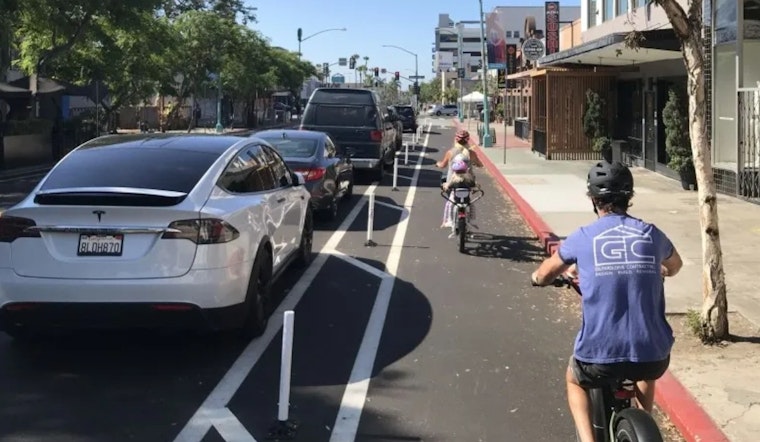
North Park’s 30th Street bike lanes are paying off in a big way. Four years after San Diego carved out protected space for bikes and scooters, the corridor is seeing record use, with roughly 130,000 trips logged in 2025 and ridership climbing every year since the lanes went in back in 2021.
The change has been sharp. In the first full year after installation, ridership more than doubled, jumping from about 50,000 annual trips to roughly 114,682, and it has continued to rise, though at slower rates. Growth clocked in at 1.7% in 2023, 5.7% in 2024, and 6.9% in 2025, according to the Times of San Diego.
How The Counts Were Gathered
To track the boom, the city uses permanent Eco‑Counter stations that tally bicycles and scooters along 30th Street and publish daily and annual totals at locations that include 30th and University. The protected lanes followed a Capital Improvements Project that replaced century‑old water mains on the corridor, a pipeline overhaul that cleared the way for restriping and the addition of separated bike lanes, according to the City of San Diego.
What Riders And Neighbors Say
People who use the route, along with bike advocates, say 30th Street feels calmer and more inviting now that there is physical separation between bikes and traffic. At the same time, they point out design and enforcement headaches. The flexible plastic posts that mark much of the bikeway are easy for drivers to run over, and the lanes are sometimes blocked by illegally parked cars. Advocates are pushing for sturdier curb‑level protection and stronger enforcement, per KPBS.
Where This Fits In The Bigger Picture
Planners point to 30th Street as proof that protective infrastructure can reshape how people move around dense neighborhoods. Regional agencies are building more separated bikeways, including SANDAG’s Pershing project, to connect these corridors into a usable network. The city has also moved to lower posted speeds in business districts that include stretches intersecting 30th Street, steps aimed at making streets safer for people walking and biking, as reported by AXIOS.
Business Impacts And Compromise
The bike lanes sparked a fierce debate early on because they removed on‑street parking, and some business owners warned that would hurt customers and deliveries. City staff later floated a compromise that would keep part of the parking while still extending a protected bikeway over a 2.4‑mile stretch. Local coverage noted that the plan would save about 100 parking spaces in business areas, even as arguments over curb space continued, per 10News.
Four straight years of growth do not erase the tradeoffs, but they give San Diego a very local case study to point to: protected bike lanes can attract riders and help energize commercial corridors when paired with stronger physical barriers, better parking enforcement and solid network connections. For a deeper, data‑heavy look at the four‑year pattern on 30th Street, check out the recent analysis from Momentum Mag.



