

























































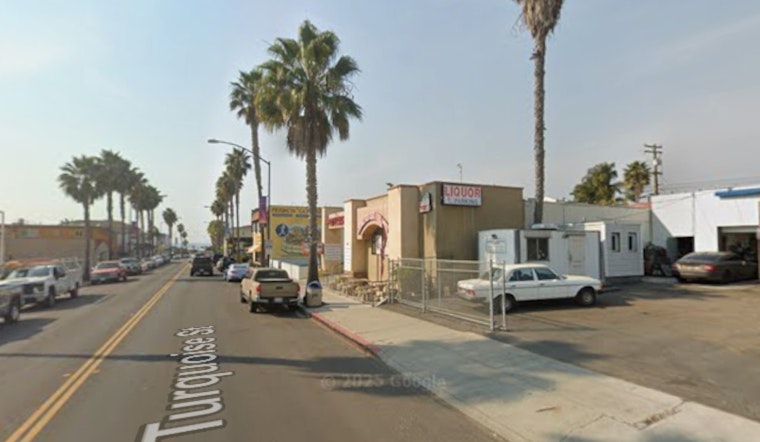
Pacific Beach is suddenly staring down a legal and political cliffhanger over a proposed high-rise that the developer insists is effectively greenlit by state law, while city officials maintain the plans are still not up to code. The 22 to 23-story Turquoise Tower would rise at 970 Turquoise Street and, if built as proposed, would dwarf the surrounding low-rise beach neighborhood.
What the plan calls for
The project, marketed as Project Vela or the Turquoise Tower, calls for a mid 70s count of apartments, including a limited number of income-restricted units, paired with roughly 139 visitor-accommodation rooms and a multi-level parking podium, according to City of San Diego filings and a public project listing. Public renderings and listings show a roughly 22-story building in the 238- to 240-foot range, with ground-floor retail stacked atop a three-story podium. The application landed at City Hall in August 2024 and has since been bouncing through repeated plan check cycles.
How the developer says it is already approved
The Los Angeles-based developer and its attorneys have pushed back hard, arguing the city blew past state review deadlines and that the permit should now be treated as "deemed approved" under state streamlining rules. Documents and correspondence circulated by local advocates show lawyers for the applicant claiming the project was automatically approved unless the city delivered a very narrow, statutorily required notice. Critics characterize that move as a bid to short-circuit public review.
City insists the review is not finished
City officials are not buying the automatic-approval narrative. They argue the claim is premature and point out that the application has needed multiple rounds of corrections. City staff told Times of San Diego that the plans submitted so far include incomplete and sometimes conflicting information, and that reviewers have been asking the applicant to fix problems rather than sign off. The city says the applicant is free to resubmit corrected plans and that technical review is still underway.
Neighbors and planning groups are mobilizing
Opposition formed almost immediately. The Pacific Beach Planning Group and a newly organized coalition, Neighbors for a Better California, have blasted the proposal as wildly out of scale and accuse the developer of stretching density-bonus rules to favor hotel-style rooms over long-term homes. Local activists have posted the attorney correspondence online and are fundraising for a potential court challenge if the city ever agrees with the developer’s deemed-approval theory, according to local coverage and community statements.
State lawmakers moved to close the loophole
Once the project became public, Sacramento took notice. Legislation led by Sen. Catherine Blakespear tightened which projects can invoke the density-bonus law, and Assembly action narrowed the use of density bonuses for transient lodging in mixed-use developments. According to a press release from Sen. Blakespear’s office and legal analyses, the updated rules curb how much commercial floor area can be boosted and require most density-bonus benefits to be tied to substantial residential floor area. Those changes, however, do not apply retroactively to projects that were already filed. Sen. Blakespear’s office lays out the measure, and legal summaries detail how it narrows the earlier interpretation.
What happens next
The developer has signaled it intent to resubmit corrected plans while continuing to press its legal argument that portions of the application have been "deemed approved." The city, for its part, says it will continue with a technical review before issuing any permit. Local officials and residents are bracing for litigation if the city accepts any automatic-approval theory, a scenario that could trigger months of filings and court hearings. For now, the project remains parked in administrative review while community groups gear up for the next procedural round.
Legal implications
Under California’s Permit Streamlining Act and related case law, a government’s failure to act can, under specific conditions, trigger a "deemed approved" remedy. Courts, however, have repeatedly stressed that statutory notice requirements and procedural steps are critical. Legal summaries and court decisions make clear that the remedy is not automatic in every situation and that it often ends up in court almost immediately. When a developer asserts a deemed approval, the result is often a fast, high-stakes legal fight over whether the application was complete, whether the deadlines actually passed, and whether the proper notices were given.
The Turquoise Tower battle is both a neighborhood land-use brawl and an early test of how cities, developers, and judges will apply the state’s housing-streamlining tools going forward. The next moves are likely to look dry on paper, full of plan corrections and legal briefs, but the outcome could reverberate across San Diego’s coastal communities.



