

























































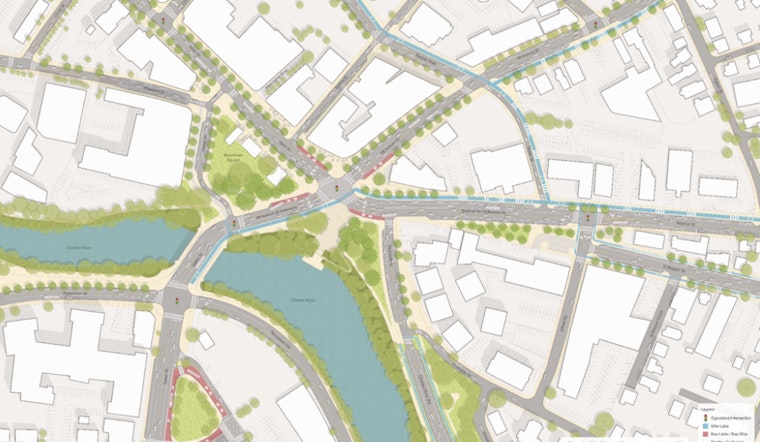
Watertown is taking the Watertown Square Area Plan off the shelf and into the real world this week, kicking off parallel efforts to craft a detailed streetscape design and a full-blown urban revitalization plan. Together, the projects will test redevelopment scenarios for the municipal parking lots behind the CVS and the Watertown Free Public Library, and lock in a construction-ready layout for the Square’s future “Four Corners” intersection.
According to the City of Watertown, the engineering contract to turn the Four Corners concept into 100 percent construction documents has been awarded to Bowman Consulting Group, while a separate consultant, Innes Land Strategies, will steer the revitalization planning. The streetscape assignment covers the full public realm, including roadways, sidewalks, protected bike lanes, bus access and a detailed inventory of underground utilities, the City says. The engineering work is expected to take up to 24 months and will result in a package the City can use to chase construction funding and permits.
As reported by Watertown News, the City Council voted in September 2025 to move ahead with a Demonstration Project centered on the municipal lots behind the CVS, the library and nearby office buildings. That Demonstration Project is expected to roll out in the early part of 2026, while the broader Revitalization Plan work is scheduled to run through the year. Possible uses on the table range from a parking garage to multi-story residential buildings, although officials emphasize that no firm development decisions have been made.
What the Four Corners Will Do
As outlined in the Watertown Square Area Plan, the redesign would simplify today’s complicated five-way junction into a more traditional four-way intersection by removing the Charles River Road “spoke” and reclaiming roughly 3.4 acres of former roadway as public open space. The plan also calls for wider sidewalks, new parallel curbside parking that is intended to better support storefront activity, and protected bike lanes that more cleanly link to the Community Path and the riverfront.
Timeline, Funding And The Legal Path
The revitalization process is following Massachusetts’ urban renewal framework under M.G.L. Chapter 121B, which lays out how an Urban Revitalization, also referred to as an urban renewal, Plan is prepared and approved, according to state guidance. For details, see Mass.gov. City officials and consultants note that roadway construction cannot begin until the engineering design is finished and funding sources are identified, as reported by Watertown News, so for now Watertown is in the careful planning phase rather than the jackhammer stage.
Next Steps For Neighbors
Public outreach will continue while consultants test what can be built where and spell out the public investments that would be required, and the City has launched a project podcast and other engagement tools to keep residents and business owners in the loop. National planners involved in the process, as well as outside coverage, note that reducing lane counts can reclaim civic space and make the Square safer and more walkable, a key rationale behind the current design direction. For broader context on the plan’s design thinking, see Public Square / CNU.





