

























































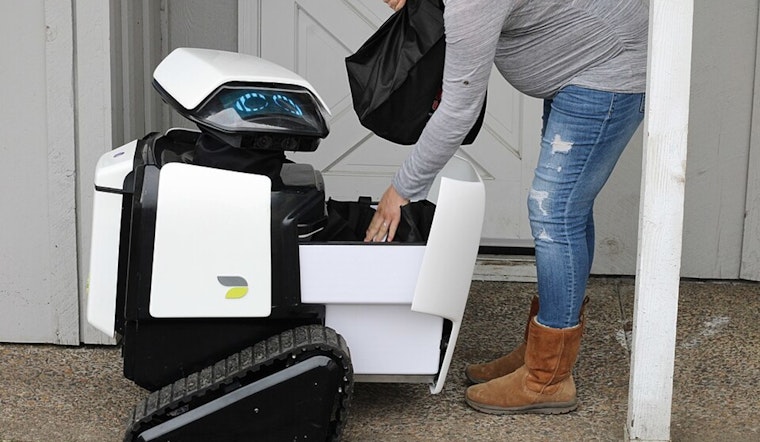
Sidewalk delivery robots might be the future of takeout in Chicago, but in the 1st Ward, they just ran into a political stop sign.
Ald. Daniel La Spata has moved to block any expansion of the robots in his ward after neighbors and disability advocates raised safety and accessibility concerns. He told constituents he would not approve growth beyond the machines’ current footprints in the 1st Ward, a decision he reached after holding a community meeting and conducting a ward survey. The result keeps limited service in place in parts of the ward while effectively capping further rollouts where neighborhood resistance is strongest.
Citywide, about 100 sidewalk delivery robots from Coco Robotics and Serve Robotics are operating under a Personal Delivery Device pilot that began after the City Council approved the program in 2022. Coco’s fleet serves Fulton Market, the West Loop, and other Near West Side neighborhoods, while Serve’s machines run on portions of the North and West sides. Customers can opt out of robot delivery inside the apps they use to order food, according to the Chicago Sun-Times.
La Spata held a virtual meeting on Feb. 2 and followed it with a ward survey that made the backlash hard to ignore: roughly 83% of respondents said they “strongly disagreed” with expanding robot operations. That response prompted him to halt future rollouts. "While I will not be asking Coco to pull back from their limited pilot area east of Wood Street, neither company will be expanding further into the ward," he said in a statement to WBEZ.
Neighbors and disability-rights advocates say the robots sometimes stop in the middle of sidewalks, get in the way of people using wheelchairs or walkers, and create confusing interactions at curb cuts and crosswalks. A petition organizer has gathered thousands of signatures and hundreds of incident reports, and city officials say companies are required to file injury reports as part of the pilot, according to CBS Chicago.
How The Companies Frame The Tech
Coco and its partners argue that the robots are meant to cut down on short vehicle trips, reduce emissions, and make last-mile deliveries more efficient. In a recent press release, Coco highlighted its zero-emission integrations with Uber Eats as part of that effort. Both Serve and Coco say their machines are programmed to move at a pedestrian pace and to slow down when they are near people. Company spokespeople emphasize the technology’s potential to ease congestion and to free human couriers for higher-value work, per PR Newswire.
Accessibility, Liability And Open Questions
Critics counter that sending unattended machines onto public sidewalks raises a host of unresolved questions. They point to lingering uncertainty over who has the right of way, who is liable if a device collides with a person, and how to ensure equitable access for people with disabilities if robots are sharing the same space.
Legal experts, advocates, and city officials are still working through who is on the hook when something goes wrong and how to measure the impact on seniors and people with limited mobility, according to reporting by NPR Illinois.
What Comes Next
For now, the robots remain authorized under Chicago’s Personal Delivery Device pilot program. The companies operate under emerging-business permits that are overseen by city departments and the City Council, which gives aldermen leverage to shape where and how the devices appear on local streets.
The pilot will require City Council action before it can continue past May 2027, and ward-level holds like La Spata’s can limit deployments in specific areas. Municipal records show recent permit renewals and ordinance amendments related to personal delivery devices, and the neighborhood pushback suggests that any permanent rules will be driven as much by local constituencies as by technology promises, per Chicago Councilmatic.





