

























































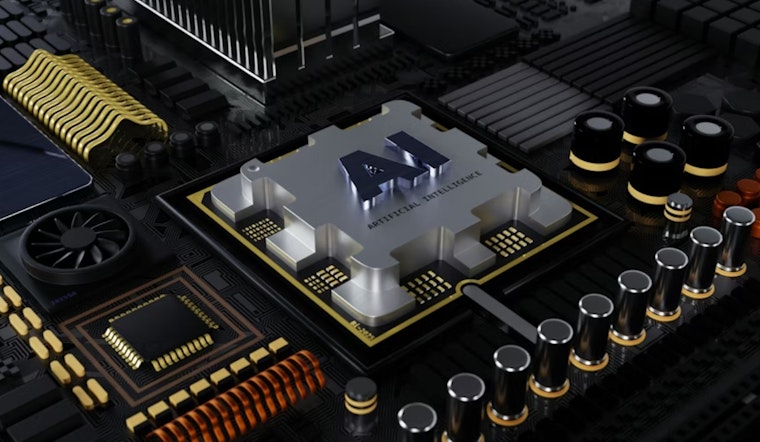
At Fort Mason in San Francisco, Arm told a room full of engineers and cloud customers that it is done sitting on the sidelines. The company is moving beyond its traditional role of licensing CPU designs and will start selling its own server processors, led by a new Arm AGI CPU and early partnerships with Meta and OpenAI. That shift drops Arm directly into the same high-stakes chip arena as Nvidia, AMD and Intel, with the announcement serving as a headline moment at the Arm Everywhere conference, a one-day gathering focused on runaway demand for AI compute.
The AGI CPU targets the energy and memory choke points inside massive AI data centers, and Arm said the effort opens roughly a $1.5 trillion opportunity across cloud, edge and physical AI, as reported by Business Insider. Company leaders cast the chip as a direct answer to a growing "compute crunch" that has hyperscalers juggling performance targets against hard power limits. Investors were quick to respond once the news hit market feeds.
Onstage, Meta infrastructure chief Santosh Janardhan warned that the company’s Hyperion cluster could eventually draw as much as 5 gigawatts of power. “If we met the performance, we couldn't get the power. If we got the power, we wouldn't get the performance,” he said, describing how engineers inside Meta scrambled to port systems to Arm hardware, according to Business Insider. Arm also told attendees it expects the AGI CPU to generate about $15 billion in revenue by fiscal 2031, positioning the product squarely at inference-heavy, agent-style workloads. OpenAI’s engineering leaders, for their part, underlined how badly they need more efficient compute just to keep their models running at scale.
Arm's Big Pivot
For Arm, this is a sharp turn from the business model it rode for decades. The company has long made its money by licensing CPU blueprints rather than selling finished chips. CEO Rene Haas framed the transition in a company essay about moving from IP to platform, and the firm used its Arm Everywhere stage, highlighted by Arm, to show how building full platforms can naturally lead into selling silicon. The "Arm Evolution" product-naming piece from Arm detailed a plan to package cores, memory and software into targeted compute platforms built for the AI era.
Why Hyperscalers Are Signing Up
Major AI operators are hunting for better performance per watt and more memory close to the CPU socket, which makes tailored processors especially appealing for inference and emerging agentic workloads that stress GPUs in different ways. TechCrunch has previously reported on Arm’s deepening relationship with Meta and the push to make Neoverse a serious cloud platform, and the AGI CPU is being pitched as a way to plug gaps where GPU-first designs fall short. Still, incumbents are pouring resources into rack-level and system-level architectures, so Arm now has to compete not just on raw silicon but on how entire systems are put together.
What To Watch
Arm’s big bet will live or die on execution: securing enough foundry capacity, solving memory bandwidth constraints and reassuring long-time licensees that the company can sell chips without undercutting its ecosystem. If Arm can deliver on power efficiency and real-world cost per token, the AGI CPU could shift who gets to write the rules for AI infrastructure. The road to that outcome, however, is anything but guaranteed.





