

























































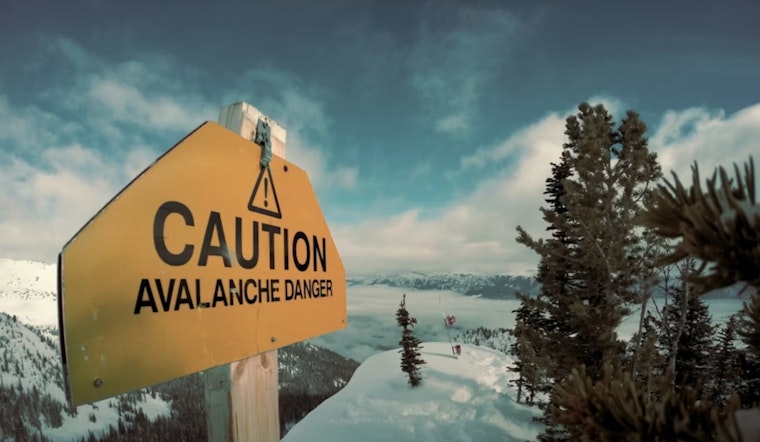
Three backcountry tourers in Colorado’s Northern San Juan Mountains had a terrifyingly close call on Saturday, narrowly dodging not one but two avalanches while skinning up the north face of the Battleship. As they worked toward the upper reaches of their line, they heard the snowpack collapse and watched a slab fracture above them. The group quickly traversed eastward across the face to exit the start zone. Roughly 30 seconds later, a second, larger avalanche ripped out. They escaped being caught in either slide and were able to radio a warning to other parties in the area.
According to a field note from the Colorado Avalanche Information Center (CAIC), the group heard a collapse, and one of the avalanches wrapped from northeast through north aspects before running almost 3,000 feet downslope. The larger slide stretched about 900 feet across, with a crown two to three feet deep in places, and piled up around 20 feet of debris on the valley floor. CAIC reported that the avalanches were remotely or sympathetically triggered from a lower-angle piece of terrain. Those details were reported by the Denver Gazette.
Slide size and slope angles
Forecasters estimate the average start-zone slope angle at about 35 degrees, even though the immediate trigger area sat in the roughly 28- to 31-degree range, a band many backcountry travelers like to think of as “safer” or borderline. The problem is that remote and sympathetic triggering allow a slide to release well above or beside a group, then sweep through start zones and into runouts. CAIC’s notes indicate that is exactly what played out on the Battleship’s north face. For the agency’s official field reports and guidance, see the Colorado Avalanche Information Center.
Context: a volatile week in the mountains
This near-miss comes in the middle of a jumpy stretch for Colorado’s backcountry. Recent storms have stacked fresh snow on top of a shallow, drought-weakened base, and forecasters have been warning that persistent-slab conditions could produce big, destructive avalanches. The Colorado Sun reported that even though fatalities so far this season are running below the long-term average, the mix of heavy new snow and fragile old layers makes remote triggering more likely, the same pattern that produced the Battleship slides.
Safety takeaways from forecasters
CAIC’s current message is straightforward: keep terrain choices simple and stay off steep avalanche slopes altogether. Forecasters recommend sticking to slopes around 30 degrees or less, carrying a beacon, shovel, and probe, and regularly practicing companion rescue. They also urge travelers to choose routes that avoid obvious start zones and runouts, read the latest field reports, and communicate clearly with other groups in the area. CAIC’s Learn resources and daily forecasts include planning checklists and real-time observations for anyone heading into the backcountry; see the Colorado Avalanche Information Center for details.
The Battleship, a prominent feature near Red Mountain Pass, has a reputation for producing avalanches, and this close call is another reminder that even dialed-in parties can get surprised. The CAIC field note and local reporting both highlight how modest-looking slopes can still trigger large, destructive slides. Checking forecasts and recent field reports before stepping into steep terrain remains non-negotiable, the Denver Gazette reported.





