

























































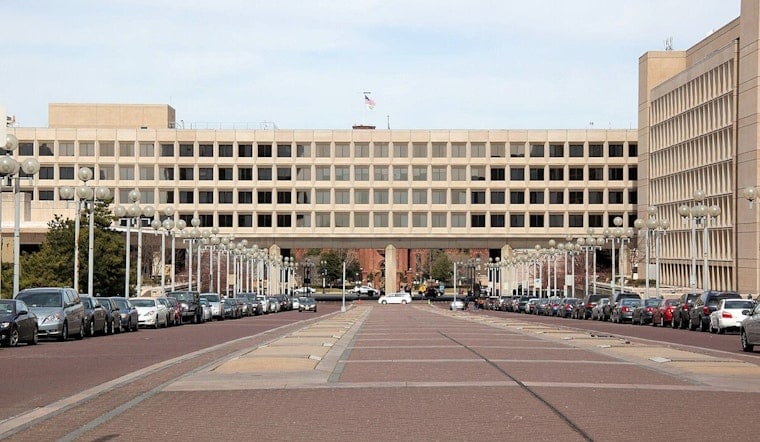
Deferred maintenance is turning big federal buildings into money pits, and it is scaring off the very buyers the government is counting on to take them over. A new interim report from the Public Buildings Reform Board pegs the maintenance and repair backlog across the General Services Administration portfolio at roughly $50 billion in overdue work, a number that is already forcing planners to ask whether some older offices are even worth saving. The tension is especially clear in Washington, where officials and developers have their eyes on large federal sites such as the Department of Energy’s James V. Forrestal complex for either demolition or full‑scale redevelopment.
The board’s 27‑page interim report, "The Cost of Inaction: Deferred Maintenance in GSA’s Portfolio," concludes the deferred maintenance and repair backlog is approximately $50 billion, more than twice GSA’s prior highest estimate, according to the Public Buildings Reform Board. The PBRB says chronic underfunding has accelerated deterioration and driven up lifecycle costs for older buildings; GSA has historically received about 0.375% of functional replacement value for maintenance, compared with an industry standard of 2-4%. The board’s analysis relied on GSA data plus third‑party sampling of representative properties to reach its estimate.
"Congress is never going to be able to appropriate its way out of this problem," PBRB Acting Chairman D. Talmage Hocker wrote, urging faster disposals and changes to the Federal Buildings Fund to make repairs feasible. The report calls for reforms that include speeding up how sale proceeds are programmed and improving data on building occupancy. It also says demolition should be considered for properties that would cost more to repair than to tear down and replace, according to the Public Buildings Reform Board.
Why buyers are shying away
Potential buyers are telling brokers and economic planners that uncertain long‑term occupancy, hidden capital needs and historic‑preservation limits make many federal buildings a risky bet, according to the Washington Business Journal. Federal News Network also reported that the board is warning many GSA‑owned buildings are now so expensive to fix that market demand has largely dried up. With low daily use and huge, aging footprints, investors often assume worst‑case renovation costs and adjust their bids accordingly, instead of paying anything close to prime market rates.
Forrestal: a case study
In D.C., planners and developers often point to the 1.7-1.8 million square‑foot James V. Forrestal complex as exhibit A for how this story plays out. A ULI Technical Assistance Panel and the National Capital Planning Commission found the complex’s operating costs top roughly $41 million a year, and immediate capital needs exceed $202 million. A JLL analysis cited in ULI’s coverage estimated that relocating the Department of Energy could avoid about $2 billion in deferred maintenance while opening the site to new redevelopment, according to the National Capital Planning Commission and Urban Land. The TAP recommended demolishing portions of the complex where adaptive reuse would not pencil out and replacing them with mixed‑use development that would stitch the National Mall to the Southwest waterfront.
Local stakes and next steps
Redevelopment boosters argue that returning marquee federal parcels to the tax rolls could throw off meaningful local revenue while also jump‑starting new housing and cultural projects. D.C. officials have already signaled they want a seat at the table as those opportunities take shape. Industry reporting indicates the board is preparing follow‑on lists of properties and that cities and developers are lining up to participate once disposals begin in earnest, according to Bisnow. Local leaders caution, however, that how and when these buildings hit the market will matter a lot: move too many at once and the government could flood the zone and push sale prices down.
GSA officials have said the agency is updating its own estimate of the backlog and have briefed lawmakers that the refreshed figure "may be eye‑popping," according to Federal News Network. Lawmakers and market players will ultimately dictate the pace of disposals and repairs. For now, though, the basic dynamic is clear: until the true capital needs are priced in and funding paths are nailed down, plenty of would‑be buyers are going to keep their hands firmly in their pockets.



