

























































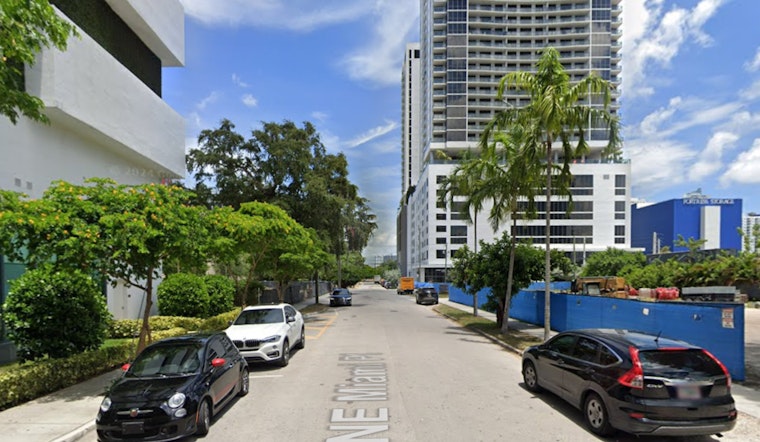
Downtown Miami’s skyline could get even busier, as a developer looks to score public incentives for a 47-story residential tower that leans heavily on workforce housing. A&E District Holding Co. has filed a request for aid to build a high-rise at 1515 N.E. Miami Place that, according to its application, would add roughly 800,000 square feet of new construction and hundreds of apartments to the Arts & Entertainment District. The pitch rests on reserving a large slice of the units as workforce housing, which the developer says would trigger tax credits and density bonuses. The filing is the latest in a wave of tall proposals that depend on state incentives to trim costs and move more quickly through approvals.
Project outline: 576 apartments, coworking, pools
As reported by Florida YIMBY, the Kobi Karp-designed tower is planned with 576 apartments and about 800,000 square feet of development. The materials describe two swimming pools, a fitness center, a spa and sauna, a pet-wash station, 10,000 square feet of coworking space, and about 4,000 square feet of ground-floor commercial space, along with 422 parking spaces. To qualify for the incentives and tax breaks laid out in its application, the developer says it would set aside 231 units as affordable, with ten units at 100% of the area median income (AMI) and 221 units at up to 120% AMI.
How the site was assembled
Bisnow reported that A&E District Holding Co., affiliated with SF QOZ Fund I, acquired a six-parcel assemblage totaling about 0.82 acres last year for roughly $20.9 million. The parcels, which include addresses along N.E. Miami Place and N.E. First Avenue falls within a federally designated Qualified Opportunity Zone, a status the buyers have said they expect to use when arranging financing. According to the Bisnow report, the fund brought on McCaffery Interests and Grandview Development as development partners and selected Kobi Karp as the project’s architect.
Why incentives matter
The decision to reserve hundreds of workforce units appears designed to qualify under Florida’s Live Local framework, which allows taller, denser multifamily development if a significant share of apartments are kept income-restricted. The Live Local Act, Chapter 2023-17, and related guidance are intended to speed up affordable and workforce housing projects by offering procedural and tax benefits to qualifying developments, according to a summary from the Florida Senate. How local governments balance those incentives against concerns about parking, shadows and strain on services has become a central flashpoint in planning debates.
What comes next
The request for incentives and the accompanying project documents are now in front of city and county reviewers and will require multiple entitlements before construction can begin. As Florida YIMBY notes, the development team is pursuing approvals and aims to coordinate financing and permits ahead of a ground-breaking, although no specific milestones or start date have been released. Neighbors and elected officials are expected to have chances to comment during public hearings as the plans advance.
Where this fits in Miami's boom
Downtown Miami, and the Arts & Entertainment District in particular, has become a magnet for new multifamily projects that rely on public incentives and flexible zoning. The Downtown Development Authority has also extended programs meant to draw ground-floor retail and jobs, according to Miami Today. At 47 stories, the A&E District proposal would slot into a crowded lineup of planned towers that developers argue are necessary to meet rental demand and make large projects financially viable amid climbing costs. For planners and residents, the open question is whether state and local incentives can truly deliver meaningful workforce housing without overwhelming neighborhood infrastructure.
Watch for formal incentive filings and planning board dates in the coming weeks as the project moves through review. If it secures approvals, the tower will offer another test case for how Live Local and public incentives are reshaping Miami’s skyline and its housing mix.





