

























































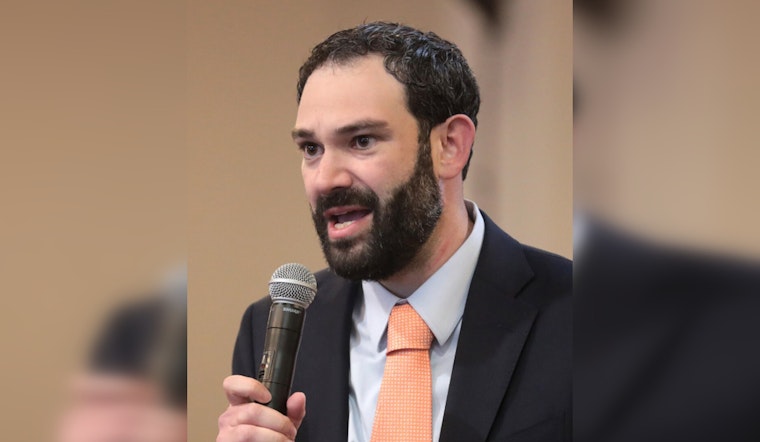
A simmering fight inside Arizona’s Republican Party just boiled over, with a former state GOP chair accusing Rep. Alexander Kolodin of privately admitting that his proposed constitutional change to election rules is designed to hit mail-in voting. The allegation lands as Kolodin pushes the "Arizona Secure Elections Act," a referendum-style measure that would tighten ID checks along with early-voting and mail-ballot rules, escalating an already heated battle over how Arizonans cast their ballots.
Gina Swoboda, who recently stepped down as chair of the Arizona Republican Party, told a KTAR radio audience that Kolodin "admitted" in a private meeting that the measure is aimed at mail-in voting and that, when she challenged him, he replied "that's because it is," according to KTAR News. Swoboda also said on air that the proposal would require mail-ballot voters to send back a postcard confirming their address and include a photocopy of a government-issued photo ID with their ballots.
What the Secure Elections Act Would Change
The measure, filed as SCR1001 in the Senate and HCR2001 in the House, would amend Article VII of the Arizona Constitution to add new identification, early-voting and mail-ballot requirements. According to the official language, voters would have to provide proof of identity to vote, early voting would end no later than 7:00 p.m. on the Friday before a general election, and mail ballots would be available only to voters who make an affirmative request and confirm a specific mailing address before each biennial general election, per the Arizona Legislature.
Kolodin’s House companion resolution cleared the chamber on a 32-27 third-reading vote, and the package has been moving through Senate and House committees as lawmakers sort through potential amendments and timing. Those roll calls and committee actions are recorded by LegiScan, which lists the House vote and recent committee activity.
How Big a Change for Arizona Voters
Mail voting is already the norm in Arizona. Nearly three-quarters of registered voters are on the state’s Active Early Voter List and routinely receive ballots by mail, according to reporting by Axios Phoenix. National coverage has similarly noted that roughly 84 percent of ballots in Arizona were cast by mail in 2024, underscoring how many people could feel the impact of new limits, according to Newsweek.
Kolodin has pushed back on criticism, telling Axios Phoenix that nothing in his plan eliminates the Active Early Voter List and that the changes are intended to "ensure that the correct ballot reaches the correct voter." Swoboda and other opponents counter that, whatever the stated intent, the practical effect would be to make mail voting harder for seniors, rural residents and tribal communities, a concern she repeated on KTAR.
Legal Questions and What’s Next
Legal experts say several provisions could end up in federal court because the National Voter Registration Act limits how far states can go in tying documentary proof-of-citizenship requirements to the federal registration form. Prior Arizona fights over documentary proof-of-citizenship and related statutes have already led courts to narrow or block similar laws, according to legal summaries and reporting by Electionline and state election guides.
The policy fight is tangled up with campaign politics too. Kolodin is running for secretary of state, while former AZGOP chair Gina Swoboda is weighing a bid of her own, and a recent roundup cited a Noble Predictive Insights poll that put Kolodin at about 17 percent and Swoboda at 16 percent, with many voters still undecided. If the Legislature signs off on the referral, the measure would go to voters on the 2026 general-election ballot, according to the Arizona Legislature.





