

























































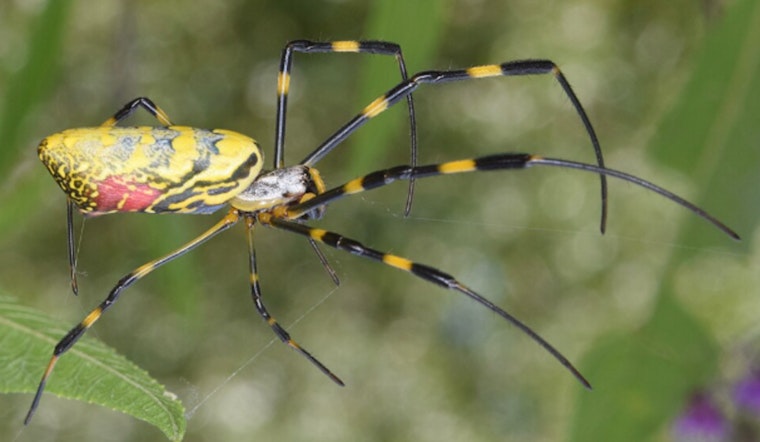
A palm‑to‑hand‑sized Jorō orb‑weaver has been confirmed in Beacon Hill, with photos of its gold‑tinged web near the State House ricocheting around social media. The bright yellow‑and‑black spider, part of a northward push that started in the Southeast, has tourists pausing mid‑selfie and neighbors trading stories on the sidewalk. For now, experts say it is more curiosity than crisis, as per WBSM.
The sighting has been traced through local coverage: as reported by WBSM, the topic resurfaced on March 26, 2026, after CBS Boston originally shared photos from Mount Vernon Street last fall. Neighbors told reporters they wanted the spider preserved for study, while researchers stressed that a single photographed adult does not automatically mean Boston has a breeding population. City photographers and community scientists are being urged to document any sightings so experts can figure out whether this was a lone hitchhiker or the start of a local cluster.
How Jorō Spiders Move Around
Scientists see two main ways this species has been shifting its range so quickly. Juveniles can "balloon" on fine silk strands that catch the wind and carry them long distances, and both adults and egg masses can quietly hitch rides on vehicles and shipped goods.
A multi‑year census and range analysis in the journal Insects (MDPI) documented Jorō detections well beyond the Southeast and noted that satellite colonies sometimes appear far from the original source population. That pattern helps explain sudden one‑off appearances in places like Boston. With both natural dispersal and human‑assisted transport at work, scientists say the spiders can pop up in new locations without much warning.
Not A Public‑Health Threat
Despite their dramatic size and coloring, Jorōs are not lining up to bite anyone. Controlled field and lab research shows they are unlikely to bite, and when they do, effects are typically minor. A study in the Journal of Medical Entomology induced bites under supervision and found low pain scores with symptoms that were short‑lived and limited to the bite area.
The study concludes that while the spiders can look intimidating, they pose little medical risk to people, and standard first‑aid for insect stings is appropriate if a bite occurs. Experts recommend basic common sense around webs rather than alarm.
Why Ecologists Are Watching
Ecologists, however, are paying close attention to how Jorōs fit into local ecosystems. In places where they become common, they can dominate orb‑weaver communities. A three‑year census in Atlanta found Jorō numbers roughly doubled each year, while native orb‑weavers dropped by about 40 percent annually. That pattern raised concerns about ripple effects on flying‑insect prey and the diversity of native spiders.
Researchers caution that those results do not guarantee the same thing will happen in New England, but they are a strong reason to collect more data from the Northeast so regions can be compared. For now, scientists are calling for careful observation, not panic.
How Bostonians Can Help And Removal Options
Residents who spot large golden orb webs are being asked to grab their phones for science. Photos and reports to monitoring efforts such as JoroWatch or other community science platforms help map whether this is a one‑off arrival or the early stage of an established population.
For those thinking about removal, a 2025 study in the Journal of Economic Entomology tested both chemical and mechanical tactics and warned that each approach involves trade‑offs. In many cases, the authors noted, careful documentation and a consultation with extension services is the better first step.
If a web on your property is becoming a nuisance, the advice from experts is to contact local extension offices or licensed pest professionals instead of trying heavy‑handed measures on your own.
In the meantime, admiring the web from a respectful distance, taking a photo, and adding it to the databases researchers rely on is one clear way to help track the Jorō's march. Whether this Beacon Hill specimen turns out to be an isolated curiosity or the start of a local population, the burst of images and reports has already made community science part of the story.





.jpg)