

























































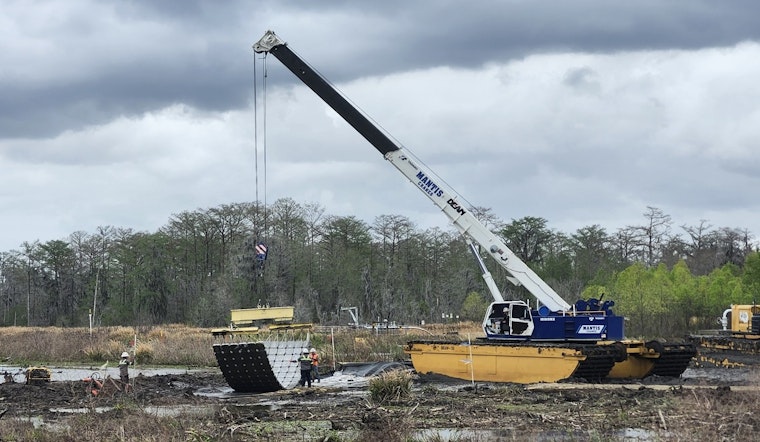
Crews working on the West Shore Lake Pontchartrain levee are keeping things busy near Garyville this week, installing articulated concrete block mattresses and pouring stabilization slabs at Site 109 along the east bank of the Mississippi River. The activity is part of the broader West Shore project, which is designed to deliver 100‑year storm surge risk reduction for communities in St. Charles, St. John the Baptist and St. James parishes. Parish officials shared photos and an update showing the mat placement and other on‑site work now in full swing.
USACE: Contract 109 Moving Ahead
According to the U.S. Army Corps of Engineers, WSLP‑109, the contract that covers roughly one mile of the system, was awarded to Cycle Construction Company on Sept. 25, 2024 and includes a pipeline‑crossing floodwall and levee built to about an 8.6‑foot elevation. The district notes that the West Shore program is relying on a mix of levees, floodwalls and pump stations to provide a 1‑percent (100‑year) level of storm surge risk reduction for the three‑parish area. The contract award followed a sequence of other WSLP reaches that have moved into construction as funding and rights‑of‑entry were secured.
Photos Show Foundation Pours And Mattress Placement
Photos from the Corps' media gallery highlight crews pouring concrete stabilization slabs at several monoliths that will anchor the pipeline crossing floodwall, while parish images show articulated block mattress placement along vulnerable sections of bank. The Corps posted an update and images on DVIDS on Feb. 11, 2026 documenting the slab pours, and St. John the Baptist Parish's March 26 update credited photographer Arielle Steers for the parish photos. Taken together, the visual record underscores the two big pieces of work at this reach: heavy concrete construction and revetment to lock the banks in place.
How Articulated Mattresses Protect Banks
Articulated concrete mattresses are built as a flexible grid of interlocking concrete blocks that act as revetment to slow currents, armor slopes and shield buried infrastructure from scour. A study of deployments on the lower Mississippi found that mattress grooves and block geometry reduce near‑bed velocities and create low‑velocity refuges, helping sediment settle and stabilizing banks, which is a key reason ACMs have become a staple on river revetment jobs. University of Dayton research documents these effects on the Lower Mississippi River.
Project Scale, Funding And What Comes Next
The West Shore system spans roughly 23 miles, with about 22 miles of levee and one mile of T‑wall, and St. John Parish accounting for about 18 miles of alignment, as the Pontchartrain Levee District progress report shows. That report notes that the U.S. Army Corps of Engineers has issued construction contracts totaling roughly $445 million across multiple WSLP reaches while additional funding and cost‑share work continue at the federal and local levels. Local officials say residents should expect rolling construction activity along the east bank as crews finish tied‑in sections, drainage features and pump station work over the coming seasons.
Where To Find Updates
The Corps and the Pontchartrain Levee District are continuing to post project updates and photo galleries as work advances, while parish officials use social channels for community notices. For technical materials and news on the program, see the U.S. Army Corps of Engineers West Shore project page, and the parish update with photos is available on St. John the Baptist Parish.


