

























































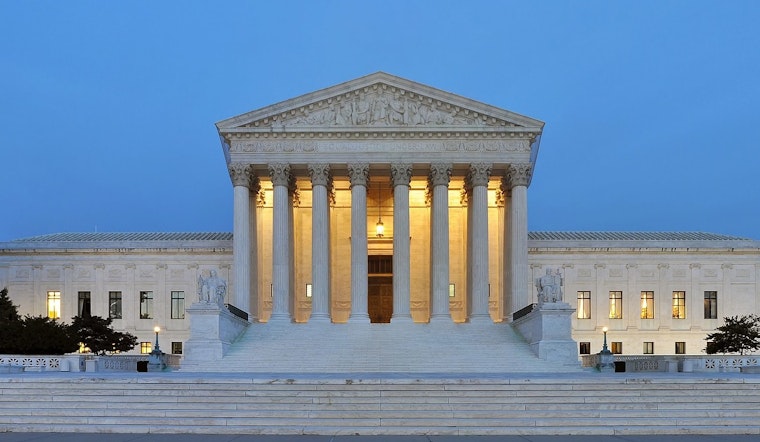
The U.S. Supreme Court on March 23, 2026, issued a 6-3 per curiam ruling that reversed the Second Circuit and held that a Vermont state police sergeant is protected by qualified immunity for his 2015 arrest of a protester. The case arose from a sit-in at the Vermont State House during Governor Peter Shumlin’s inauguration, where Sgt. Jacob Zorn removed demonstrator Shela Linton using a rear wristlock. Justice Sonia Sotomayor, joined by Justices Kagan and Jackson, filed a forceful dissent warning that the decision further narrows already limited paths to hold officers accountable.
The unsigned majority opinion faulted the appeals court for not pointing to prior precedent that clearly barred the use of a standard rear wristlock, applied after warnings, as a constitutional violation. It concluded that “Zorn was entitled to qualified immunity.” According to the Supreme Court, the qualified immunity inquiry demands precedent that puts an officer on notice with a high degree of specificity before liability can attach. Broad statements about excessive force, the Court emphasized, are not enough.
What Happened at the State House
The confrontation traces back to January 8, 2015, when roughly 200 health care demonstrators stayed inside the Vermont State House after closing and officers began arresting those who declined to leave. As recounted in Justia, witnesses and video showed Zorn taking Linton’s arm, moving it behind her back into a rear wristlock, applying pressure, and lifting her to her feet. Linton says the maneuver left her with permanent wrist and shoulder injuries along with psychological harm, and she sued under 42 U.S.C. § 1983 alleging excessive force. The district court first granted Zorn summary judgment, the Second Circuit vacated that decision and sent the case back for trial, and the Supreme Court has now cut that off with its reversal.
In dissent, Justice Sotomayor, writing for herself and Justices Kagan and Jackson, argued that the Court’s decision to summarily overturn the Second Circuit was unjustified and that a reasonable jury could find Zorn violated Linton’s clearly established Fourth Amendment rights. She warned that the majority’s approach “essentially requir[es] Linton to find a factually identical case,” and she labeled the ruling an improper contraction of accountability. Those passages are drawn from her signed dissent as released by the Supreme Court.
Why It Matters
The decision tightens the Court’s already demanding “clearly established” standard, making it tougher for plaintiffs to get past summary judgment in excessive force suits unless they can point to precedent with almost matching facts. Legal commentators note that the ruling fits a broader pattern of the Court requiring highly specific prior cases before denying qualified immunity, a trend discussed in detail on SCOTUSblog. For protesters and civil rights lawyers, that means fewer avenues to hold individual officers personally liable under § 1983.
Legal Implications
On the ground, the ruling signals that many excessive force claims built on more general case law may now be stopped at the pleading or summary judgment stage unless plaintiffs can cite closely analogous decisions. The Second Circuit had leaned on its Amnesty America line of cases in allowing Linton’s claim to move forward, but the Supreme Court concluded that precedent did not clearly establish the specific rule at stake, as outlined in Justia. Civil rights attorneys caution that the decision may weaken incentives for departments to discipline or retrain officers unless legislatures or agencies step in with policy changes.
In the short term, the ruling sharply narrows Linton’s ability to recover damages in federal court and confirms the sergeant’s qualified immunity shield. Local coverage of the decision is available from WFMD, with more extensive legal analysis on SCOTUSblog. Justice Sotomayor’s dissent underscores that the fight over qualified immunity is not going away and will keep driving clashes in courts and statehouses alike.



