

























































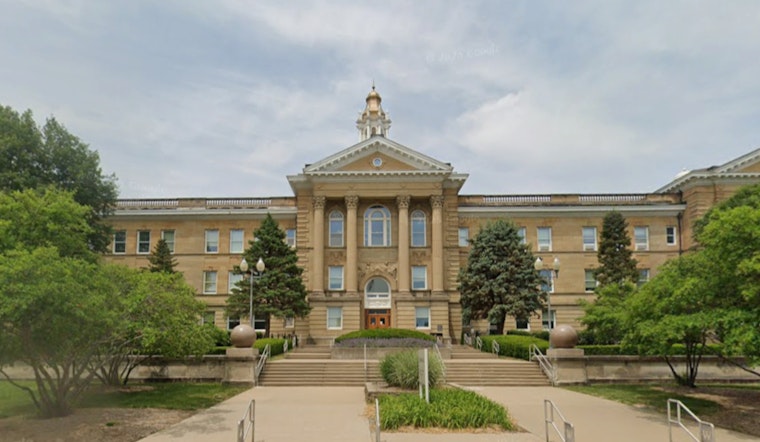
On Wednesday the Illinois Supreme Court rolled into Western Illinois University in Macomb, turning the University Union Grand Ballroom into a traveling high court for a day. Students, lawyers and local officials packed the room as the justices heard two cases with big statewide stakes: one over when judges can deny pretrial release in violent-offense cases, and another over how far a school district must go to provide bus service to students at a private Catholic school in East St. Louis.
According to the Illinois Courts, the session was part of the court’s long-running Riding the Circuit program and was held in WIU’s University Union Grand Ballroom. Western Illinois University published case summaries, streamed the arguments and listed the matters as People v. Marshall (No. 132129) and E.W. v. Board of Education of East St. Louis School District No. 189 (No. 131757).
Livingston County Defendant Challenges Pretrial Detention Rules
In People v. Marshall, court filings describe a Livingston County man charged in 2025 with aggravated battery after prosecutors say he punched Sergeant Andy Rork of the sheriff’s office, fracturing Rork’s nose. As recounted in the Fourth District Appellate Court opinion in People v. Marshall, the trial court denied Marshall pretrial release and the appellate court affirmed, setting the stage for a fight over how strictly courts must police procedure in detention challenges.
The technical but high-stakes question in front of the justices is whether failing to raise certain arguments in a required post-trial motion means a permanent waiver, or instead a forfeiture that higher courts can still review in limited circumstances. The answer will help shape how precisely defense lawyers must preserve issues when someone is being held before trial and how much flexibility reviewing courts have if something was missed the first time.
East St. Louis Bus Battle Tests School-Transport Law
The second appeal zeroes in on Section 29-4 of the Illinois School Code and how far it requires public districts to go in transporting nonpublic-school students. The Fifth District Appellate Court opinion in E.W. v. Board of Education traces the conflict to a 2015 court order that required East St. Louis School District No. 189 to provide transportation for students attending Sister Thea Bowman, a private Catholic school. The opinion notes the district stopped those special routes in August 2022, triggering fresh litigation.
The key legal puzzle is whether districts must run separate routes specifically for eligible private-school students, or if it is enough to offer pickup points along existing routes serving public-school pupils. The statutory language at the center of that debate is found in Illinois General Assembly text for 105 ILCS 5/29-4, which lays out when and how nonpublic-school students are supposed to be transported.
Why These Rulings Could Echo Far Beyond Macomb
Attorneys have been quick to point out that the bus case is not just about one East St. Louis school. Local reporting notes that lawyers argue the outcome could affect hundreds of districts and how they structure routes and budgets, with one attorney quoted as saying the statutory question touches "800-plus" districts. As reported by WQAD, that potential reach is a big part of what gives the East St. Louis appeal statewide significance.
The visit also doubled as a hands-on civics lesson for western Illinois. Tri States Public Radio noted that Riding the Circuit is designed to make the often-abstract work of the state’s highest court visible to students and communities that rarely see it in action.
What Happens After The Court Packs Up
With oral arguments wrapped, the justices will now dig into the briefs and trial records before issuing written opinions. Parties and observers expect rulings later in 2026. Until the Supreme Court speaks, lower courts remain guided by the existing Fourth and Fifth District decisions in these cases, and school districts, defense attorneys and prosecutors will be watching closely for any shift in the rules. We will monitor the court docket and post updates once the opinions are filed.





