

























































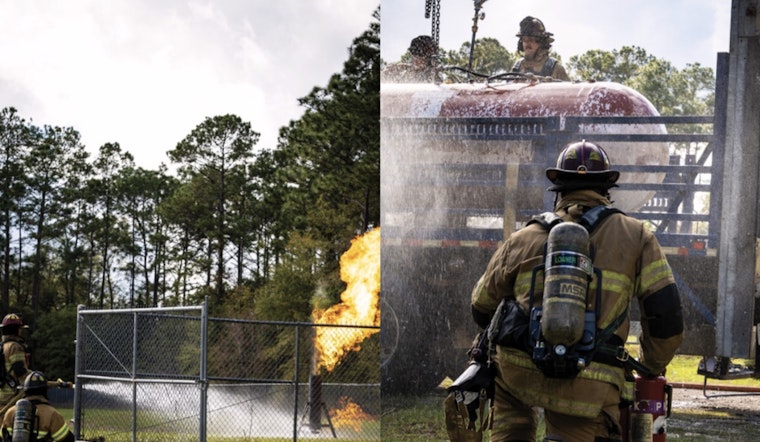
What started as a faulty valve on a 1,000-gallon propane tank turned into a hours-long hazmat operation in Jacksonville on Thursday, as Jacksonville Fire Rescue’s HazMat team moved in to stop a dangerous gas leak and burn off the fuel before it could ignite on its own.
According to a post from the Jacksonville Fire Rescue Department, a malfunctioning service valve allowed propane vapor to escape from the large tank. HazMat technicians re-plumbed the tank and set up a controlled burnoff, a flaring tactic that routes escaping gas to a burner where it can be safely ignited and burned away. The strategy relieves pressure in the tank and cuts the odds of an uncontrolled fire or explosion while crews keep the area secure and continuously monitor conditions.
The department said C-shift crews from stations 64, 34, 37, 35 and 49 provided the manpower on scene, while the HazMat team supplied specialized equipment, mitigation support and nonstop air monitoring. All told, Jacksonville Fire Rescue reported that crews spent roughly four hours controlling the vapor release and completing the burnoff.
How flaring works and why crews use it
Flaring, often carried out with a portable flare tower or tools sometimes nicknamed the “red dragon,” gives responders a controlled way to deal with leaking propane. Instead of letting gas pool and drift, they reroute it to a designated burner where it can be ignited and steadily burned off so pressure inside the tank can safely drop.
The typical setup involves re-plumbing the tank, raising a flare stack, cooling nearby surfaces and checking the surrounding air for any dangerous buildup, a playbook documented in local coverage and state hazmat guidance, as reported by News4JAX and described by the Maryland Department of the Environment.
What Jacksonville crews reported
In its Facebook post, the Jacksonville Fire Rescue Department said a service-valve malfunction allowed propane vapor to escape and that HazMat technicians “controlled a vapor release” before moving into the burnoff phase. The department listed the specialized tools brought in for the job, including a tank liquid-evacuation valve, and described the controlled burn as a pressure-relief measure that reduces the chance of a much more dangerous fire or explosion.
Safety takeaways for neighbors
Propane vapor is heavier than air and can settle in low spots, which is why a tall, visible flare from a controlled burn can actually be the safer option. By pulling fuel out of a damaged tank and burning it in a known location, responders limit where that gas can travel and what it can reach, according to industry safety guidance.
For residents, the rules stay simple. If you smell gas, leave the area immediately, stay away from anything that could create a spark and call 911 along with your propane supplier. The Propane Education & Research Council offers detailed safety steps for both homes and businesses.
Jacksonville Fire Rescue shared photos and a short account of the operation on its social media channels. Anyone with questions about propane safety can turn to industry resources or contact the department directly for official information.





