

























































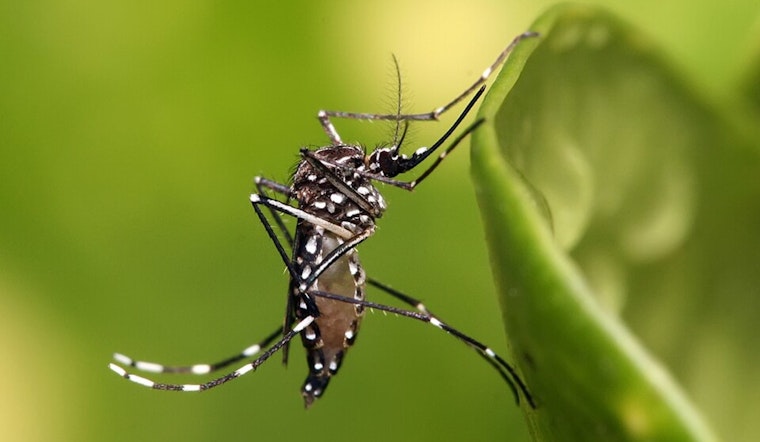
If it feels like the mosquitoes in Los Angeles are overstaying their welcome, you are not alone. As the buzzy invaders linger deeper into the year, county vector officials are pitching a high-tech solution and a modest new fee to pay for it. The Greater Los Angeles County Vector Control District wants authority to collect up to $20 a year from single-family homeowners to expand releases of sterilized male mosquitoes, on top of the district’s existing assessment. Early pilots, officials say, have already driven invasive Aedes numbers way down in test neighborhoods.
Pilot shows big drops in treated neighborhoods
In a pilot program in Sunland-Tujunga, the district released non-biting, sterilized male Aedes aegypti on a weekly schedule and tracked what happened next using traps and hatch-rate monitoring. Field data from that focused effort showed roughly an 82% reduction in wild adult mosquitoes in treated areas compared with nearby control zones. The test involved releases totaling on the order of hundreds of thousands of sterile males. Those results are the main evidence district leaders are weighing as they consider a broader rollout, according to the Greater Los Angeles County Vector Control District.
A small fee to scale the program
District officials say that turning a neighborhood experiment into a countywide operation will take new money. Their proposal would add up to $20 a year per single-family home to build out the mosquito rearing, irradiation, and release capacity needed at scale. That charge would sit on top of the roughly $18.97 that homeowners already pay for current vector services. Before anything becomes permanent, the district plans to send sample ballots and go through the Proposition 218 process to gauge support and secure legal authority. The Los Angeles Times has reported those figures and the outreach plan.
How the sterile-male method works
The basic playbook is simple, if not exactly low tech. Technicians sterilize male Aedes mosquitoes, typically with X-ray irradiation, then release them into places where wild males are plentiful so they can compete for mates. When females pair with the sterilized males, they still lay eggs, but those eggs do not hatch, which cuts into the next generation of mosquitoes. District staff stresses that the released males do not bite and that this method avoids broad pesticide spraying over neighborhoods. As the district has explained in local coverage, the mosquitoes are raised, sterilized, and released week after week to keep pressure on the population. CBS Los Angeles has detailed those operations and shared staff comments.
Local pushback and politics
Support for the extra charge is far from unanimous. The district’s general manager reports that single-family homeowners tend to be more open to the idea in surveys, while fewer business owners are on board with another line item on property bills. Some municipal and commercial leaders have also questioned stacking a new assessment on top of existing costs. District officials counter that they cannot scale the sterile-male program on the current budget and are framing the proposed fee as a narrowly targeted way to pay for a countywide expansion. Those budget arguments and outreach talking points have been laid out in recent briefings and in coverage by The Los Angeles Times.
Public-health stakes
For health officials, this is not just about itchy ankles. Aedes aegypti can transmit dengue, chikungunya, and other arboviral diseases, and local transmission has already occurred in recent years. The World Health Organization notes that dengue infections can bring high fever, rash, and nausea, and in a small share of cases can progress to severe illness. That risk is a key reason vector control agencies keep describing Aedes suppression as a public-health priority.
What happens next
The district has begun its outreach push, including sending sample ballots and digital surveys to property owners as part of the Proposition 218 process. Officials say they will keep tracking pilot data and public feedback before formally asking property owners to approve any new assessment. If the returned property-owner ballots meet the legal threshold set out in Proposition 218, the additional charge could move ahead. The timeline and next steps for that process are spelled out in recent board packets and staff reports from the Greater Los Angeles County Vector Control District.





