

























































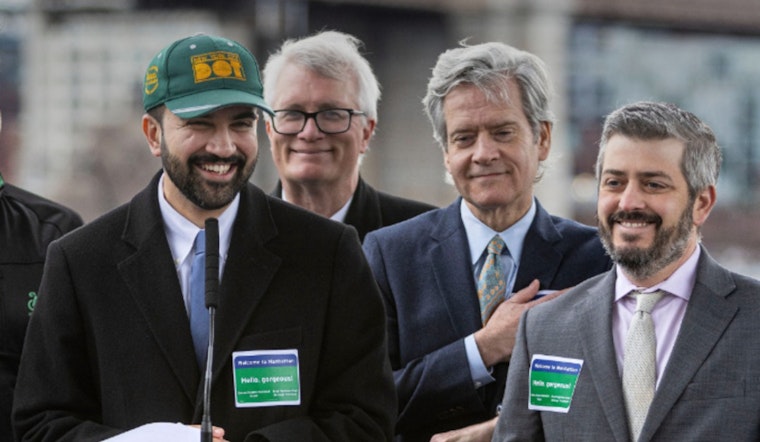
Mayor Zohran Kwame Mamdani is fast-tracking a dedicated Manhattan-side bike lane and a separate pedestrian entrance at the Brooklyn Bridge, with City Hall aiming to get the work done before this summer’s FIFA World Cup. The project targets the cramped landing where cyclists and pedestrians currently tangle near Centre Street and Park Row, a daily headache for commuters and tourists. Officials say construction will be relatively quick and is meant to ease one of downtown Manhattan’s most notorious choke points.
The plan surfaced first in the mayor’s post on X, and local reporting from Streetsblog New York City reports that the Department of Transportation will begin work in April, with a target completion in June. City Hall is pitching the project as part of a short list of street upgrades timed around the World Cup, with the stated goal of letting people cross the bridge "on their feet, on their bikes, and with ease."
We’re building the Manhattan-side bike lane and pedestrian entrance to the Brooklyn Bridge in time for the World Cup. New Yorkers deserve to enjoy the game on their feet, on their bikes, and with ease. https://t.co/tke64OTM8L
— Mayor Zohran Kwame Mamdani (@NYCMayor) March 27, 2026
What DOT Will Build
The specific design was presented to Community Board 1 and detailed in an NYC Department of Transportation packet. According to the NYC Department of Transportation presentation, the plan shifts cyclists off the bridge promenade and into a barrier-protected two-way bike lane along Centre Street and Park Row. The project converts the existing southbound left-turn bay into protected bike space and widens the sharp 180-degree turn that currently forces riders to snake through crowds of pedestrians.
DOT’s materials also call for vertical barriers and clearer signage, along with moving authorized-vehicle parking to nearby blocks. The agency says that change is intended to preserve emergency access while eliminating the chaotic mixing zone where riders and walkers now compete for the same narrow space.
Why It Matters For Riders And Visitors
Protected bike lanes on the Brooklyn Bridge led to big jumps in cycling after the 2021 reconfiguration, and DOT counts show that growth has continued, turning the Manhattan landing into a constant pressure point. City data published after the 2021 changes recorded major increases in bike crossings, and advocates argue that a dedicated on-street connection will cut down on dangerous conflicts at the base of the span; see NYC DOT for the ridership figures.
City officials say the Brooklyn Bridge entrance overhaul is also part of the city’s World Cup game plan, as the administration works to prep streetscapes for an expected surge of visitors this summer, a theme the mayor’s office has highlighted in recent briefings.
Timeline, Traffic And What To Expect
DOT’s traffic analysis suggests the conversion is unlikely to create major vehicle bottlenecks. The design reduces the size of the turn lane but projects only modest delay changes while preserving capacity for the roughly 700 vehicles that now make the turn during peak hours. Local reporting indicates that DOT expects to start work in April and wrap up by June so the upgraded entrance is ready in time for World Cup crowds.
The agency’s packet recommends extending no-standing zones and shifting authorized parking to nearby blocks to keep emergency routes open during and after construction. Those steps are intended to keep the approach functional for drivers and emergency responders even as more space is handed over to people on bikes and on foot; see the NYC Department of Transportation presentation for the technical traffic analysis.
What Is Next For The Corridor
City Hall says the Brooklyn Bridge fix is one of several quick, high-impact street projects the administration plans to roll out this spring, including bus lanes and road-diet completions across Brooklyn and the Bronx. The mayor’s office has also announced a restart of multiple paused bike and bus projects as part of a broader push to improve safety and mobility.
DOT officials plan to coordinate community notifications and traffic control plans before crews move in. Riders, neighbors and nearby businesses are being urged to watch for agency notices about block-by-block timing and temporary curb-rule changes. The city says the goal is for the brief disruption to pay off with a bridge landing that stays safer and more accessible long after the final World Cup whistle.




