

























































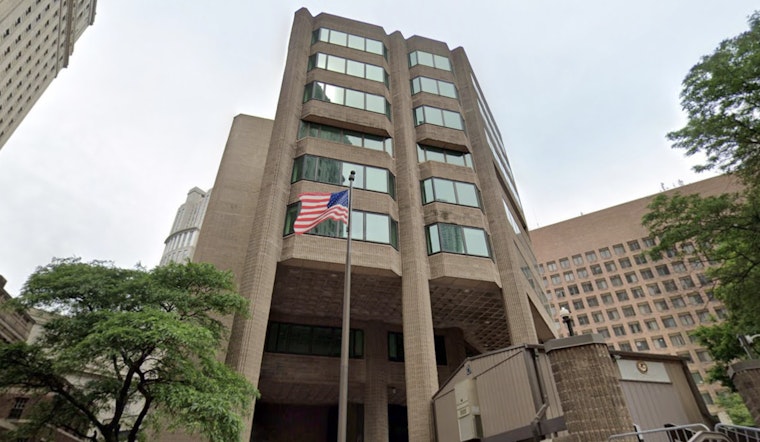
A long, bruising legal battle over a 36-story Midtown Manhattan office tower has finally cracked open, and hundreds of victims of Iranian state-sponsored terrorism are now in line for roughly $318 million.
Federal prosecutors said Monday that the settlement, tied to the building at 650 Fifth Avenue and related properties, caps more than 17 years of forfeiture litigation. An initial $129 million payment was completed on March 20, 2026, with another $189 million set to follow later under the deal.
U.S. Attorney Jay Clayton did not mince words about the broader backdrop, saying, “Iran has sponsored terrorism for decades,” in a brief post on X shared by the U.S. Attorney’s Office. That post pointed readers to the department’s announcement of the settlement.
Settlement terms and immediate steps
In a press release, the U.S. Attorney’s Office for the Southern District of New York said the United States reached a settlement resolving the 17-year forfeiture action that will result in approximately $318 million being paid to victims, including an initial $129 million payment made March 20, 2026 and a deferred $189 million payment in three years plus interest, according to the U.S. Attorney’s Office, SDNY.
Under the agreement, the partnership that owned the building will be dissolved, with the property transferred to a new successor entity. Prosecutors noted that the transactions received signoff from the New York Attorney General’s Charities Bureau and the U.S. Department of the Treasury’s Office of Foreign Assets Control.
Assistant U.S. Attorney Michael D. Lockard is listed as overseeing the civil forfeiture action. The U.S. Attorney’s Office credited the investigative work of the FBI, the IRS and the NYPD in getting the case across the finish line.
Why 650 Fifth Avenue was central
The 36-story tower was built by a foundation tied to the shah of Iran and for years has been at the center of allegations that Iran used front companies to hide ownership and channel rental income to Bank Melli, the state-owned Iranian bank. Court filings, trial records and appellate decisions describe a partnership structure involving the Alavi Foundation and Assa Corporation that prosecutors say concealed the bank’s stake in 650 Fifth Avenue.
A more detailed account of the litigation history and rulings in the case can be found in federal appellate records summarized by Justia.
Who will benefit
According to the U.S. Attorney’s Office, the settlement will send compensation to “hundreds of victims” of Iran-sponsored terrorism. Those beneficiaries include family members of victims of the 1984 bombings of U.S. military facilities in Beirut, people injured or killed in the September 11, 2001 attacks in New York and Washington, D.C., and civilians targeted by Iranian proxy groups in Israel and other locations.
Prosecutors noted that earlier settlements with victims’ groups had already laid the groundwork, providing that any recovery obtained through forfeiture actions connected to the building would be distributed to those judgment creditors, in line with the terms described by the U.S. Attorney’s Office, SDNY.
Legal notes
The case and its resolution sit squarely at the crossroads of forfeiture, sanctions and victim-compensation law. Statutes such as the Terrorism Risk Insurance Act and the U.S. Victims of State-Sponsored Terrorism Fund shape the framework for when and how money like this actually reaches individual claimants.
A Congressional Research Service report explains how allocations, conditional payments and overlapping claims can tangle distribution timelines and affect how much individual victims ultimately see. For a deeper look at those mechanics, see the analysis from CRS.
For now, the settlement closes a long-running legal chapter in Manhattan and routes a substantial recovery to long-suffering victims. But while the first payment has already gone out the door, the remaining funds and final distributions will be processed through the existing claims system, which means it could still take time before all of that money lands in individual victims’ hands.




