

























































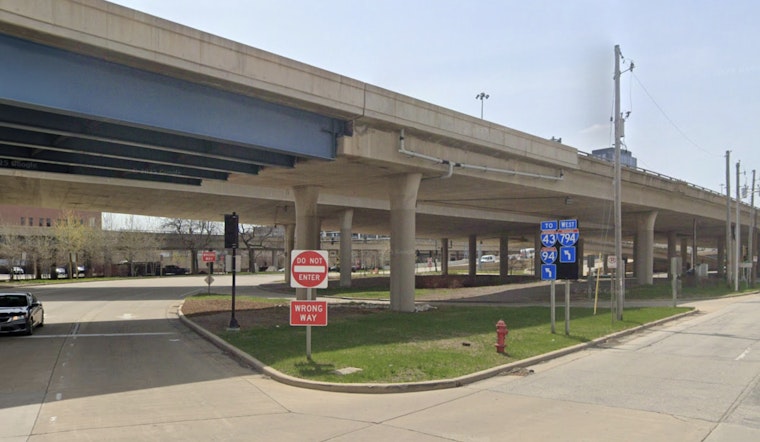
Rethink 794 and a group of allied planners want Milwaukee residents to stop speeding over I-794 and walk it instead. On Tuesday, they are inviting the public to stroll the downtown stretch of the freeway, a roughly 30 minute tour followed by a group discussion that asks people to picture the corridor as something more than an elevated strip of concrete. The goal is to help residents see how the aging structure could be traded for streets, parks and housing that reconnect the Historic Third Ward with downtown.
Event Details
The Walk & Roll audit is scheduled for noon on Tuesday, starting outside the U.S. Bank Center at 777 E. Wisconsin Ave. Organizers say the route, expected to take about 30 minutes, will be led by architect Taylor Korslin and 1000 Friends of Wisconsin transportation policy analyst Raphie Torralba. A post-walk discussion is planned near the Colectivo Coffee in the building's galleria, according to Urban Milwaukee.
What Advocates Say
Rethink 794 argues that the east-west portion of I-794 could do a lot more for Milwaukee if it came down to street level. Their pitch: convert the freeway into an at-grade boulevard and unlock land for housing, parks and commercial space instead of elevated ramps.
An economic analysis prepared with urban planner Larry Witzling estimates that the conversion could accommodate more than 3,000 housing units and roughly $1.1 billion in increased property value over 30 years, per Rethink 794.
Where WisDOT Stands
The Wisconsin Department of Transportation notes that much of the I-794 corridor dates back to the mid 1970s and that 28 original bridge units are nearing the end of their useful life. WisDOT is studying a few broad options through its I-794 Lake Interchange Study: replace the freeway in kind, reconstruct it with design tweaks, or remove it and build an at-grade boulevard in its place.
The agency’s timeline shows the study advancing into environmental review, with final design and construction timing dependent on funding and a schedule that stretches toward 2030, according to the Wisconsin Department of Transportation.
Opposition And Concerns
Not everyone is ready to trade ramps for crosswalks. Opponents, including some suburban commuters and real estate interests, argue that removing the freeway could push more vehicles onto local streets and snarl traffic on nearby corridors such as I-43.
A separate analysis cited by Finance & Commerce suggested that under certain removal scenarios, freight and commute times could lengthen in ways that carry measurable regional costs. Business groups have pointed to those findings as a reason to favor more conservative rebuild options.
How To Take Part
The walk is open to the public, and organizers say the route is designed to be accessible for people using wheelchairs, bicycles or other mobility devices. American Sign Language interpretation will be available.
Additional event details and registration are listed on Rethink 794.
Next Steps
WisDOT plans more outreach this spring focused on potential land use impacts and is expected to identify a preferred alternative later this year as the study moves toward environmental review. Organizers say walking tours like Tuesday’s are intended to gather on-the-ground observations and public feedback that they hope will influence recommendations to planners and elected officials.





